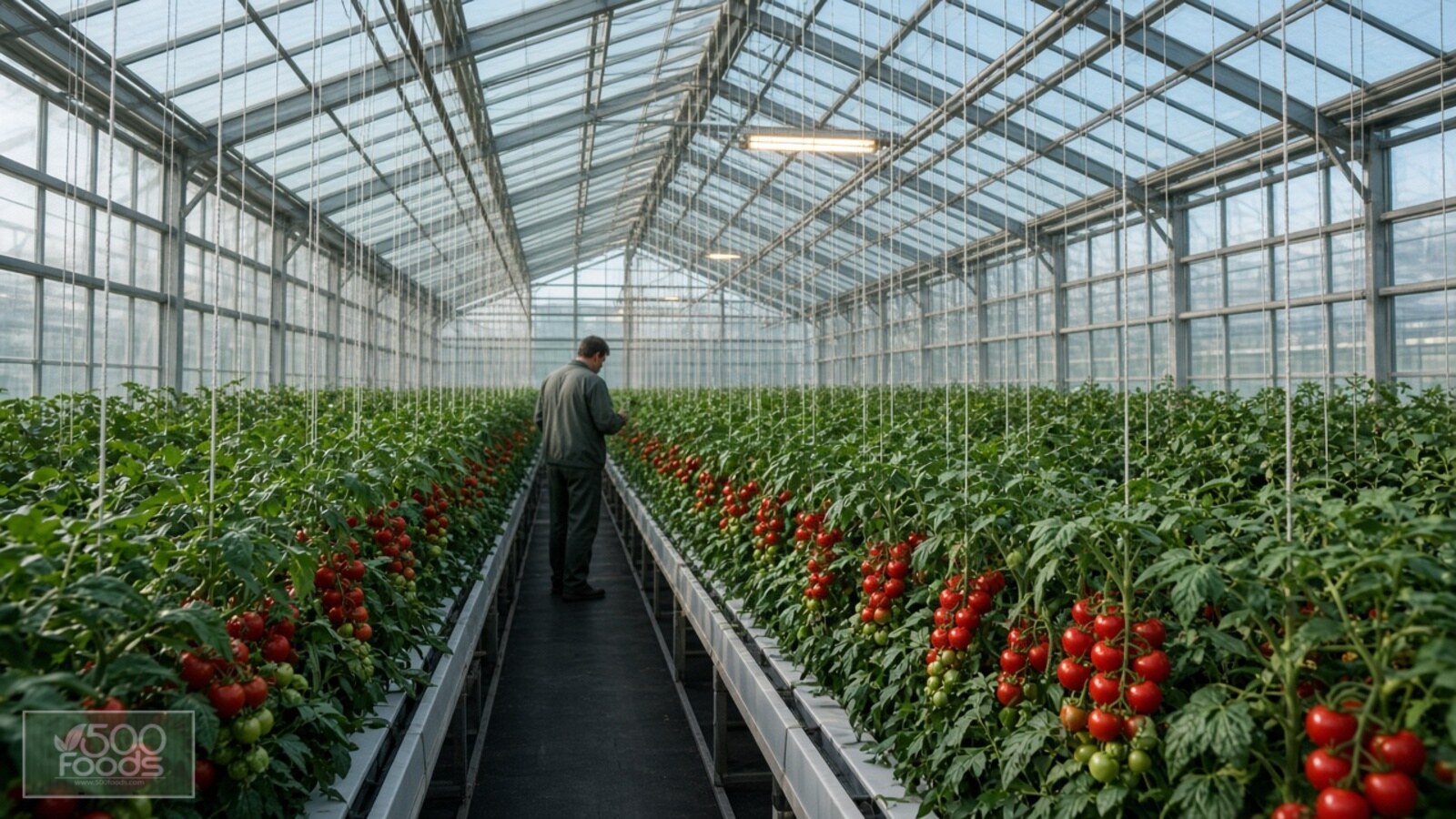
Conventional greenhouse tomatoes are tall, branchy and labour-hungry. Phytoform Labs, based at Rothamsted Research in Harpenden, has been editing elite varieties into a short, tidy architecture that barely makes side shoots. In a HortiDaily item of 26 November 2026, lead tomato genome engineer Dr Antony Chapman describes a trait meant for controlled-environment production, now on trial in greenhouses and vertical farms.
Short plants, few side shoots
Chapman says the team screened many candidate genes before finding a combination that was short enough without becoming a dense bush. The edits act on genes conserved across tomato varieties, so the trait can be moved into other backgrounds more easily than a typical dwarf cross. A UK precision-breeding release notice of 3 November 2026 (PBR/26/013) says two genes were inactivated by targeted deletions in isolated tomato cells, shortening the stem between leaves and reducing branching on the main stem.
Most dwarf varieties, Chapman has argued, are poor parents because almost every trait except size is weak. An earlier Phytoform account describes a miniaturised form of the elite variety Ailsa Craig, about one-sixth the usual plant size, aimed at vertical farms whose typical tier height is only 40 to 60 cm. Company figures from that stage suggested 50 to 100 plants per square metre and up to three cycles a year. Those numbers have not been independently confirmed, and the 2026 HortiDaily report is more cautious: the first line was a proof of concept, and larger trials still have to show whether the model holds.
Jointless fruit and a shorter cycle
Phytoform is also adding a jointless fruit stalk, so the tomato parts from the plant without a stub of stem. The leftover stalk on conventional fruit complicates packing, can damage neighbouring tomatoes, and is one reason destemming is still done by hand — a barrier to mechanical harvest. The trait is about 50 years old, Chapman notes, but has been hard to handle in breeding. Combined with a compact, almost unbranched plant, it is meant to cut hand work from planting through to the packhouse.
A shorter crop may also change the disease calculation. Chapman describes a cycle of roughly four months, or even two months in the greenhouse if plants are held longer in trays, with harvest before an outbreak has time to build. The first proof-of-concept line has no disease-resistance package, which he says was expected; later varieties will have to show whether the plants are useful once resistance is added.
What this means in a container
Trials of the first version have run in vertical farms and greenhouses in the United Kingdom and the United States, with work now under way in Australia. The company is moving the trait into higher-value material, starting with cherry tomatoes and then into types familiar to greenhouse growers. That work now sits alongside AutoTom, a three-year Defra and Innovate UK Farming Innovation Programme project led by CambridgeHOK (Cambridge Glasshouse Company), with the University of Lincoln, APS Produce Group, the British Tomato Growers' Association and Phytoform as partners. The official award, announced in January 2026, is £1,755,172. The bid is to combine compact plants with conveyor-based handling and harvest, aiming at labour savings and yields of about 45 to 50 kg per square metre per year — project targets, not results.
For container and rack growers, the interest is practical: a short, low-maintenance fruiting crop is what leafy greens already are, and what high-wire tomatoes are not. Container Culture has already covered this systems question from another angle, in a Wageningen perspective paper on small-statured tomatoes for automation. The open questions are the ones Chapman flags: disease resistance, fruit quality in commercial backgrounds, and whether larger trials match the early claims.
References:
- The 'tiny' tomato is on its way to the greenhouse of the future, HortiDaily (26 November 2026)
- Tiny tomatoes that pack a punch, Phytoform Labs
- $4Mn funding secured to transform greenhouse tomato production, Phytoform Labs
- From precision-bred hemp to Sunshine Tomatoes: £21.5m to drive farm innovation in England, Department for Environment, Food & Rural Affairs (31 January 2026)
- Precision breeding release notice (reference: PBR/26/013), GOV.UK (3 November 2026)
How we find, write and illustrate these stories, and how you can share them: see Welcome to Container Culture.
AI-generated post text and image content are shared under CC BY 4.0.