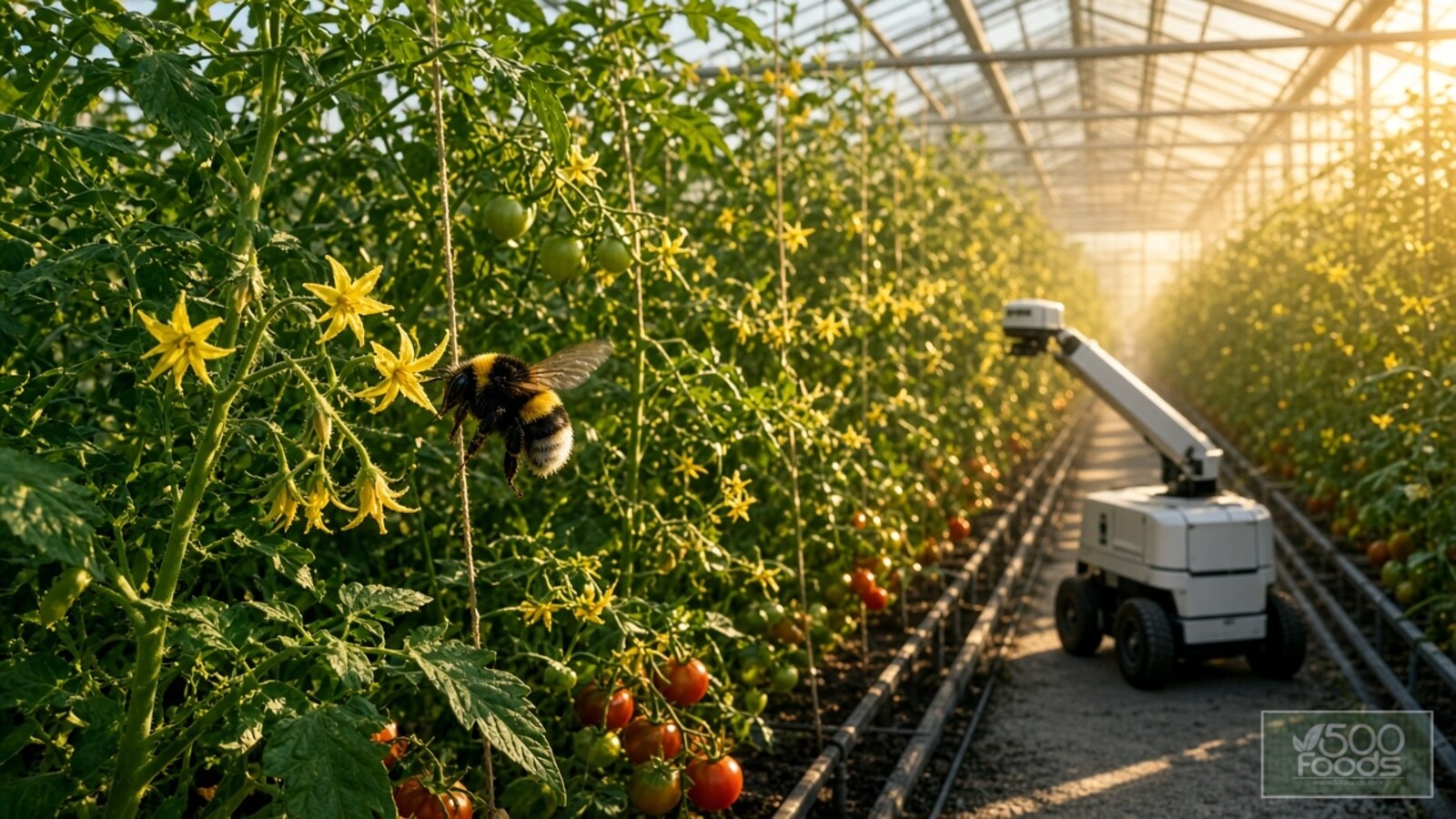
Pollination rarely makes headlines in the produce business, yet almost every fruit on a tomato vine starts with it. This week Biobest, one of the companies that turned commercial bumblebee hives into a standard greenhouse input, began selling a pollination robot called Polly, developed with Israeli start-up Arugga AI Farming. The machine itself is less interesting than the problem it is aimed at: pollination is a quiet bottleneck in food production, and it is under pressure both outdoors and under glass.
Why pollination matters
The international science panel IPBES has estimated that more than three quarters of the leading global food crop types benefit to some degree from animal pollination, and that crops directly tied to pollinators are worth hundreds of billions of US dollars a year. Those crops include many of the fruits, vegetables and nuts that supply much of the vitamins and variety in our diets. At the same time, wild and managed pollinators face habitat loss, pesticides, parasites, disease and a changing climate. For growers, a pollination shortfall does not usually mean no crop. It means smaller, misshapen or uneven fruit, and lower yields that are hard to spot until harvest.
The greenhouse version of the problem
Tomatoes are self-fertile: each flower carries both pollen and stigma. However, the pollen has to be shaken loose, which outdoors happens through wind and buzzing insects. In a sealed greenhouse there is little wind, so for decades growers vibrated each truss by hand. Since the late 1980s, managed bumblebee colonies have largely done that job, and they are now part of the routine in high-tech tomato houses.
Bees have limits, though. According to Biobest, short winter days, low light, LED supplementary lighting and energy-saving screens all reduce bumblebee activity, and temperatures above about 35°C slow them down in summer. Some regions do not allow imported bumblebee species at all; mainland Australia is the best-known example, where many growers still pollinate with handheld vibrating wands. Moving colonies and people between houses can also matter during plant-virus outbreaks such as tomato brown rugose fruit virus. Each of these gaps falls back on labour, which is expensive and increasingly hard to find.
What the robot adds
Polly uses cameras and image recognition to find flowers that are ready, then releases short puffs of air to free the pollen. Biobest says trials in commercial greenhouses in Europe and North America showed yield gains of 2 to 6 percent, and that about 1.5 percent is usually enough to pay for the robot. One unit can now cover roughly a hectare a day from an autonomous base. These figures come from the vendor, not independent trials, so growers will want results from their own crops and conditions.
Notably, Biobest is pitching the robot as a supplement to bumblebees rather than a replacement: a way to keep pollination steady through the dark weeks and heat waves, and an option where bees cannot be used.
The bigger takeaway
For the wider industry, the point is not one machine. It is that pollination is moving from a background assumption to a managed, measured input, like irrigation or lighting. Growers are tracking fruit set more closely and covering weak spots. Outdoors, the same thinking shows up in hedgerow planting, hive rentals and pesticide timing. Whether the answer is bees, robots or better habitat, reliable pollination underpins steady supply, consistent quality and fair prices.
References:
How we find, write and illustrate these stories, and how you can share them: see Welcome to Ag Articles.
AI-generated post text and image content are shared under CC BY 4.0.