The modern greenhouse tomato is a ten-metre vine. In the high-wire system that has dominated glasshouse production for about 50 years, each stem is wound up a string, lowered and leaned along overhead wires, and stripped of side shoots and old leaves week after week for an eleven-month season. It delivers remarkable yields, but it is built around human hands. A new perspective paper from Wageningen University & Research, highlighted by HortiDaily, asks whether tomatoes need to get much shorter before they can be properly automated.
The labour problem
Led by Zixin Yao with horticulture professor Leo Marcelis and colleagues in the Netherlands, the United States and Japan, the authors note that labour makes up roughly 31% of Dutch tomato growing costs, and hours per hectare have barely moved in fifteen years. Large-fruited high-wire crops need about 7,500 hours per hectare per year; cherry tomatoes up to 17,000. Leaf-cutting robots exist, and harvesting robots have been demonstrated, but a tall canopy that changes shape every week is a hard place for a machine to work.
Two shorter alternatives
The paper compares two small-statured systems against high-wire:
- Dwarf tomatoes: compact, determinate cultivars under 40 cm tall, grown in pots at 20 to 100 plants per square metre, finishing in 70 to 100 days. Using autonomous greenhouse trial data, the authors estimate 30 to 45 kg per square metre per year and roughly 4,000 labour hours per hectare.
- Limited-truss tomatoes: ordinary indeterminate varieties pinched after one or a few trusses, planted densely and cycled about four times a year. Estimated output is 24 to 60 kg per square metre, with 5,400 to 5,900 labour hours per hectare.
Neither matches the 111 kg per square metre of lit, large-fruited high-wire crops, and both have a lower harvest index. Dwarf types also bear small fruit of 7 to 9 grams. The trade is less yield for much simpler, more uniform plants.
Why plant architecture matters in racks
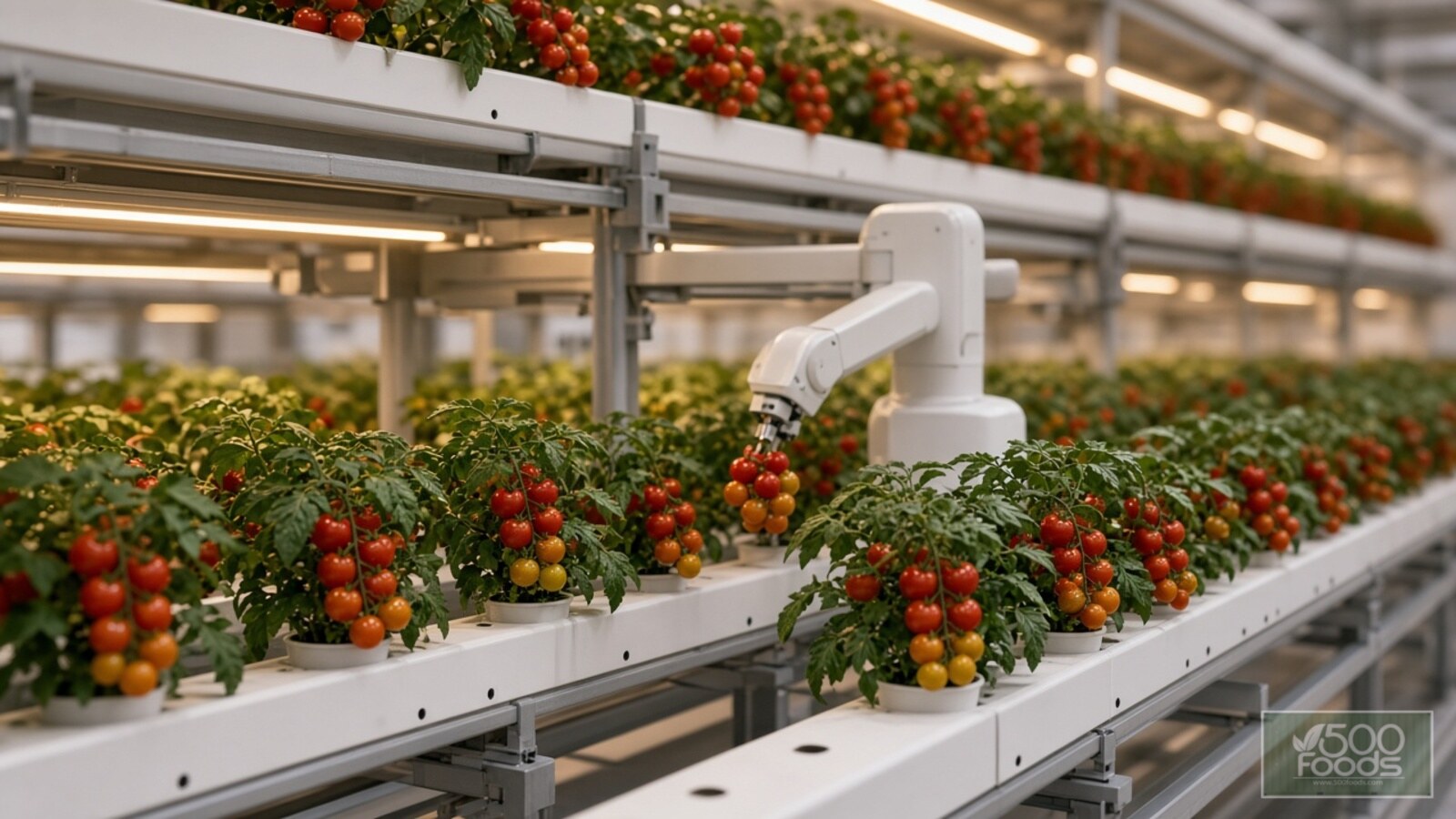
For container and vertical growers, the dwarf option is the interesting one. A plant under 40 cm fits a rack tier. Short cycles mean every plant in a batch is at the same stage, so lighting and climate can be tuned for leafy growth early and fruit quality later, instead of compromising for a canopy that is doing everything at once. The authors sketch a movable-gutter layout where plants travel to a robot or worker station, rather than staff walking the rows, with different compartments set for different crop stages.
That is close to the logic of aisle-less container farms: standard units, moving racks and labour done in one place. It also makes cameras and sensors more useful, since a short, uniform crop is easier to scan for ripeness, pests and ground cover.
What still has to be solved
The paper is candid about the gaps. Bushy dwarf plants and pinched limited-truss plants both still need side-shoot removal, which is fiddly for robots. Plants that are too compact can hide fruit from a harvester. Dense planting and short cycles multiply seed and seedling costs, and much of the labour data for limited-truss systems dates from 1990. Most dwarf tomatoes today are sold as potted plants, not bred for commercial fruit yield. Breeding, crop modelling and economic analysis all need to catch up, and the authors expect high-wire to stay dominant wherever labour is cheap.
For stacked production, though, the direction is clear. Leafy greens fit racks because they are small and quick. If breeders and engineers can deliver a tomato with the same habits, fruiting crops become a realistic option for container farms.
References
- Yao Z, Marcelis LFM, de Koning ANM, Giacomelli GA, Higashide T, Heuvelink E (2026). Small-statured tomato plants for automating greenhouse production: opportunities, constraints, and research priorities. Frontiers in Plant Science 17:1966159. DOI: 10.3389/fpls.2026.1966159
- Transitioning from high-wire tomato cultivation to highly automated cultivation for small-statured plants, HortiDaily, 30 October 2026.
How we find, write and illustrate these stories, and how you can share them: see Welcome to Container Culture.
AI-generated post text and image content are shared under CC BY 4.0.