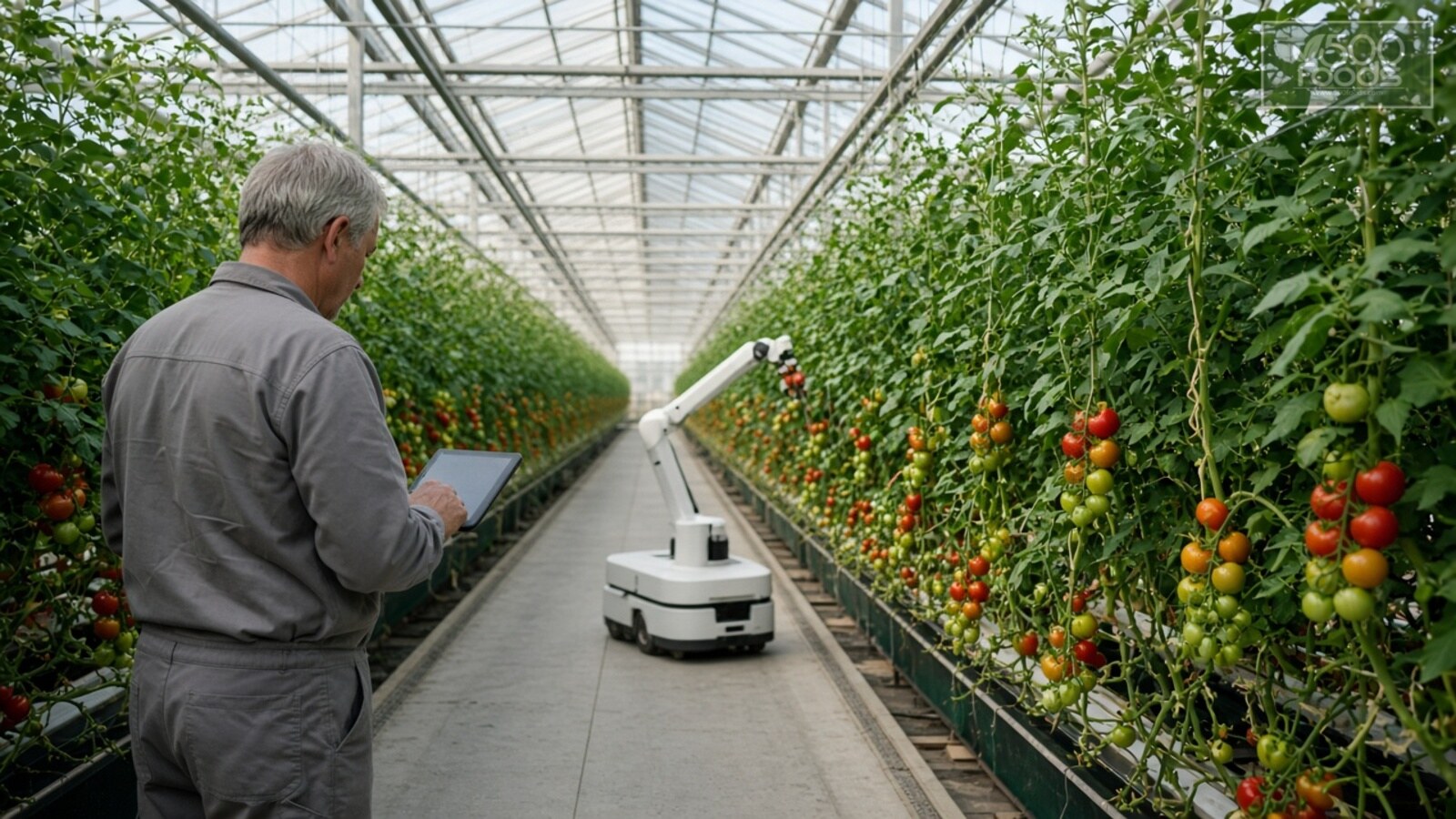
Labor has accounted for 30% to 50% of turnover in Dutch greenhouse horticulture for years, depending on the crop and the growing system. Most of the work is practical and repetitive — planting, pruning, harvesting, sorting and packing — done by Dutch staff and seasonal workers from other EU countries. A new RaboResearch scenario study, highlighted by HortiDaily, asks what happens to that labor force by 2035 if workers become scarcer, and if robotization, artificial intelligence, autonomous growing and data-driven cultivation move from trials into everyday practice.
A slow rise in productivity
Between 2011 and 2024, inflation-adjusted gross value added per annual work unit rose by only 0.86% a year, to €94,118. The sector created €4,462 million of gross value added in 2024. Authors Lambert van Horen and Arne Bac argue that pace is probably too slow to keep greenhouse work attractive on a tight labor market.
The average hides large differences. Cut-flower farms raised gross labor productivity by 3.3% a year even as their area shrank 26%, from 2,428 hectares in 2011 to 1,794 in 2024, likely because the firms that remained were the ones that automated. Greenhouse vegetables, whose area grew 9% to 5,455 hectares, managed only 0.5% a year; pot and bedding plants, up 28% to 1,741 hectares, saw virtually no gain. Using Wageningen's Agrimatie data, the authors note that those last two sectors may still have more room to automate.
Four routes to 2035
The scenarios were built with Glastuinbouw Nederland, the Federation of Fruit and Vegetable Organisations (FVO), Wageningen Economic and Social Research, Florpartners and Rabobank. They turn on two uncertainties: how much labor the sector can still recruit by 2035, and how fast new technology is adopted. Scenarios 1 to 3 hold Dutch glass area constant. In a contraction path, area falls 20% because vacancies go unfilled and technology does not replace the missing people; some firms may move abroad.
- 1a. High growth (labor scarce, adoption high): robotization toward autonomous growing, with value added rising 3% a year. By 2035: €5,996 million, 39,000 annual work units (19,000 practical, 20,000 specialized), and a 45.7% wage share.
- 1b. Moonshot (labor scarce, adoption very high): 3% growth until 2030, then 5%. By 2035: €6,601 million, 35,000 work units (12,000 practical, 23,000 specialized), wage share 40.7%.
- 2. Controlled acceleration (labor plentiful, adoption high): stepwise modernization at 2% a year. By 2035: €5,439 million, 43,000 work units (26,000 practical, 17,000 specialized).
- 3. Muddling through (labor plentiful, adoption low): limited innovation at 1%, close to the historical trend. Employment stays at 48,000, almost today's level (35,000 practical, 13,000 specialized); value added €4,928 million.
- 4. Contraction (labor scarce, no technological renewal): productivity is flat. Value added falls to €3,645 million and employment to 39,000 (33,000 practical, only 6,000 specialized).
In the first three scenarios the wage bill stays near €2.7 billion even as the mix of work changes; in the contraction path it drops to €2,032 million. Successful technology adoption can raise the sector's total value even as employment falls, with more of that value coming from depreciation on robots and autonomous systems.
Different people, different skills
The jobs that remain look less like picking and more like process control, machine operation, data analysis and scouting for biological crop protection. They will have to be hired or trained, and they will cost more, with costs coming first. After 2040, if automation scales, specialized roles may later shrink, but first they have to grow.
For container and vertical growers, stacked production only works if labor is concentrated, skilled and scarce. Without a technology leap, a labor shortage can shrink the industry.
References
- Van Horen L, Bac A (2026). Meer doen met minder handen: vier scenario's voor de arbeidsproductiviteit in de glastuinbouw. RaboResearch, 25 November 2026.
- Four scenarios for labor productivity in Dutch greenhouse horticulture, HortiDaily, 26 November 2026.
How we find, write and illustrate these stories, and how you can share them: see Welcome to Container Culture.
AI-generated post text and image content are shared under CC BY 4.0.