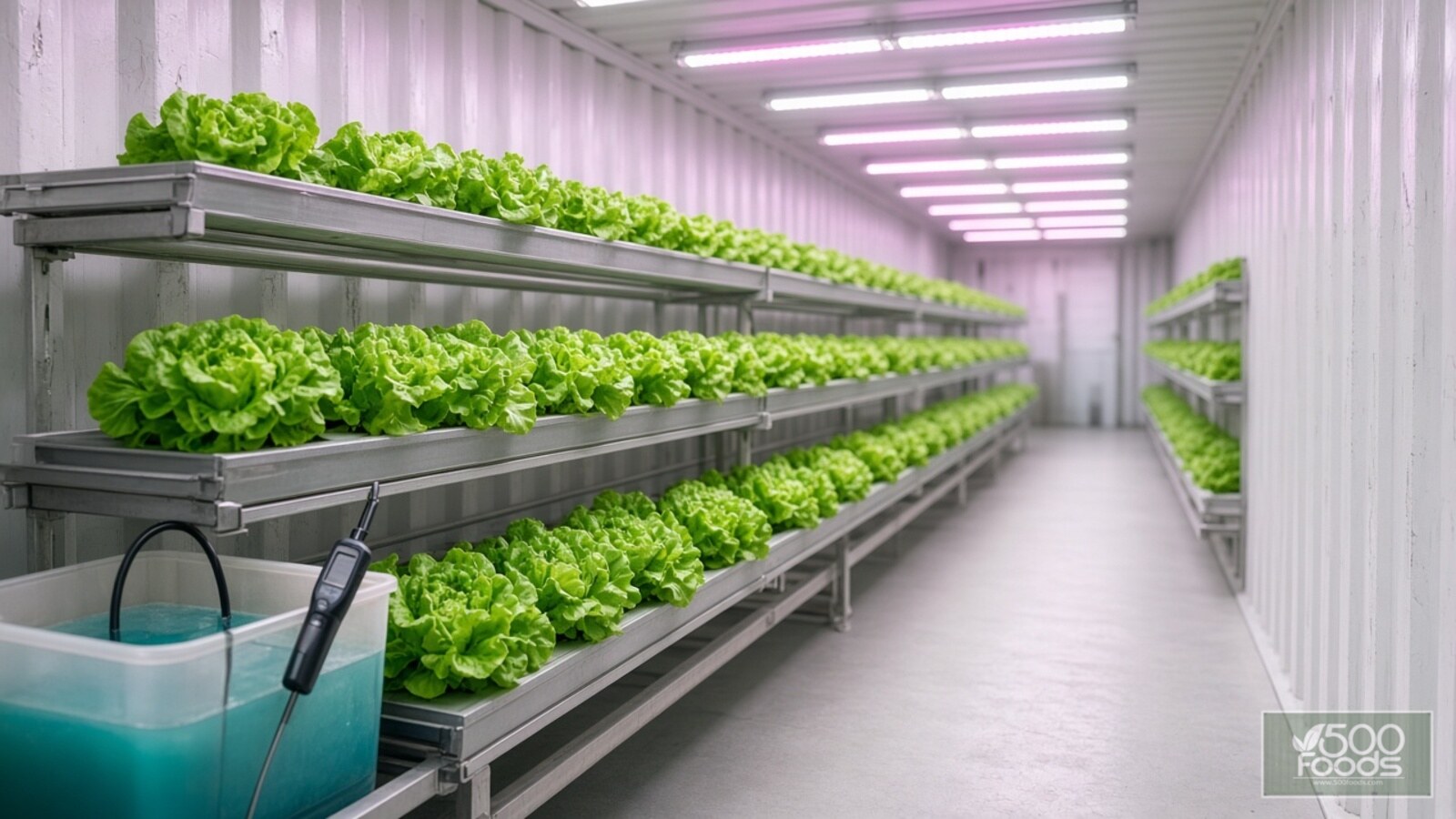
Researchers in Virginia found that hydroponic lettuce held up under potassium levels four times higher than usual. The plants only slowed down when the extra potassium came as potassium chloride and pushed the nutrient solution's EC to about 4 dS·m⁻¹. For container and vertical-farm growers, the lesson is to watch total EC and which fertilizer salts they use, not just the potassium number.
Lettuce is the workhorse crop of container farms and vertical farms, and most of those operations feed it through a hydroponic nutrient solution that the grower mixes from individual fertilizer salts. Potassium is one of the big three nutrients in that mix, but how much is too much has been surprisingly unclear. A new study in HortScience, covered by HortiDaily, gives a practical answer: the potassium usually isn't the problem, but the salt it arrives in can be.
The experiment
A team from the Institute for Advanced Learning and Research in Danville and Virginia Tech's School of Plant and Environmental Sciences grew lettuce in a controlled environment. They fed the plants potassium at four levels: 274, 548, 822 and 1096 mg per litre. The top level is roughly four times the starting rate. They ran the series twice, once with potassium chloride (KCl) and once with potassium sulfate. A third set of treatments added ordinary table salt (sodium chloride) to the KCl solutions so that every treatment had the same electrical conductivity (EC) as the strongest one. The team also imaged the plants throughout the crop to track how growth changed over time.
What they found
- Plenty of headroom. With KCl, the three lower rates produced lettuce of the same size and weight.
- Trouble only at the top. At 1096 mg per litre from KCl, plant size and fresh and dry shoot weight all dropped.
- Potassium wasn't to blame. The same high potassium supplied as potassium sulfate caused no growth loss. When sodium chloride raised every KCl treatment to the same EC (about 4.0 dS·m⁻¹), the treatments no longer differed. High EC, not potassium, slowed the plants.
- Damage builds slowly. The imaging showed no difference for the first two weeks. After about day 15, the high-EC plants grew more slowly, and the gap widened the longer they stayed on that solution.
What it means in a container
Container and vertical-farm systems often recirculate their nutrient solution. Ions the crop doesn't take up, such as chloride and sodium, can therefore build up over a cycle, and EC can drift upward without anyone adding more potassium. This study suggests two easy habits. First, choose fertilizer salts for their companion ions as well as their nutrients: potassium sulfate or potassium nitrate add less salt load than potassium chloride. Second, track EC across the whole crop, not just at mixing time, because the yield penalty only appeared in the second half of growth.
The work also explains why recipe comparisons between farms can mislead. Two solutions with the same potassium figure can behave very differently if one is built on chloride and the other on sulfate.
References:
- Effect of Potassium Source and Increasing Concentration on Lettuce Growth Produced in a Controlled Environment, Doss, South, Lowman & Evans, HortScience 61(10): 2311–2316 (2026)
How we find, write and illustrate these stories, and how you can share them: see Welcome to Container Culture. Text and AI-generated images are shared under CC BY 4.0.