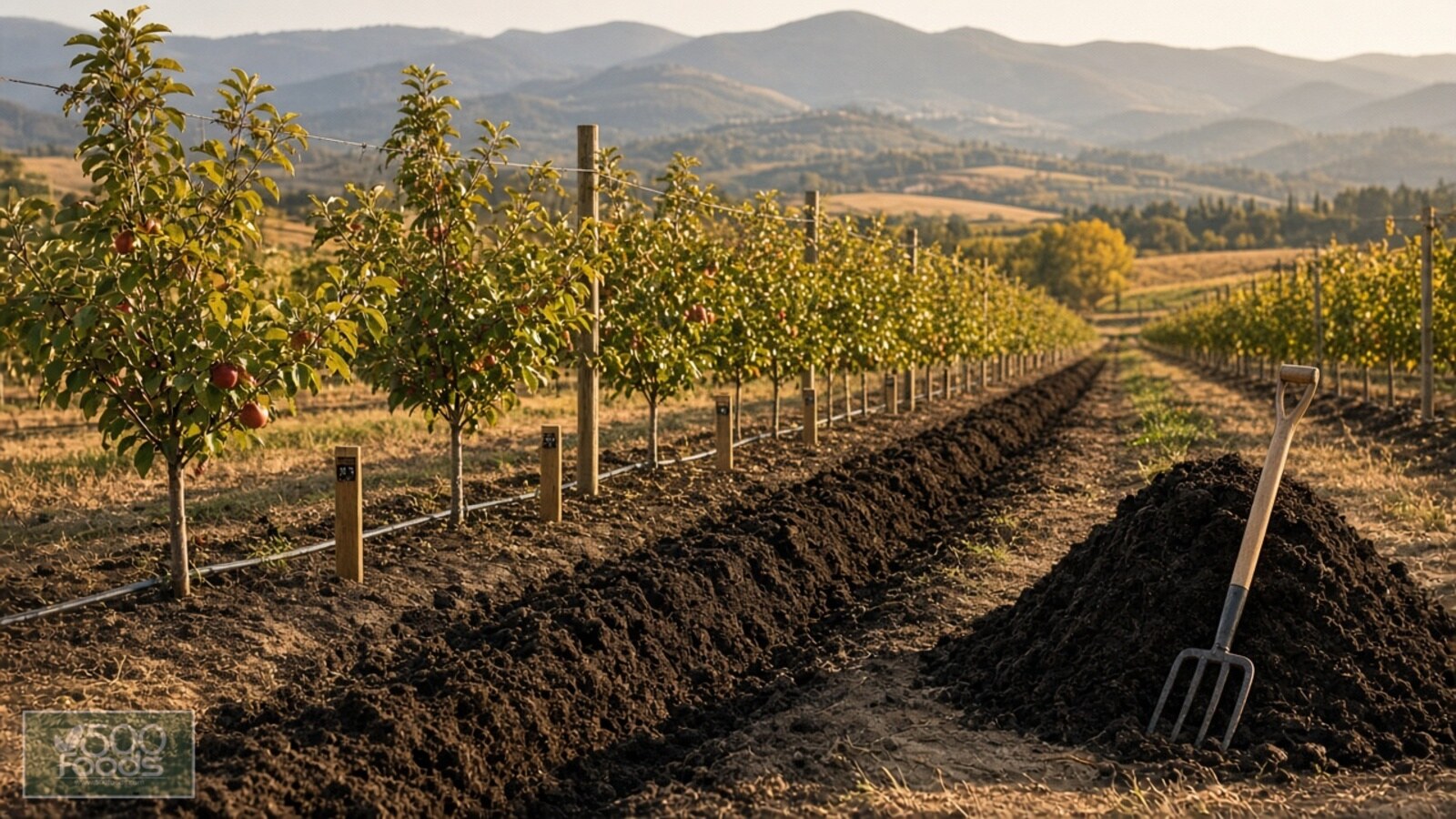
Most growers moving away from a purely synthetic fertilizer program do not flip a switch overnight. They replace part of it first and watch what happens. A new study in HortScience offers an unusually long look at that middle path: nine years of apple production in which 30% of the chemical fertilizer was swapped for different organic amendments, with the same total nitrogen going on every plot.
The trial
Researchers ran the experiment from 2015 to 2024 in a commercial-style 'Fuji' apple orchard near Weihai in Shandong Province, China, on a calcareous brown soil with a cool, monsoon-influenced climate. The trees were on M9-type dwarfing rootstock at about 1,800 trees per hectare, and fertilizer was placed in trenches beside the rows.
Six treatments were compared, each in three replicate plots of 40 trees:
- Chemical compound fertilizer only, for all nine years.
- 70% chemical plus 30% composted poultry manure, for nine years.
- 70% chemical plus 30% composted sheep manure, for nine years.
- 70% chemical plus 30% of a commercial bio-organic fertilizer, for nine, six or three years (the shorter runs started after several years of chemical-only feeding).
The organic material went on as a single post-harvest base application, while the chemical share was split across budding, early fruit growth and post-harvest.
What changed
Yield rose with the length of time organic inputs had been used. Nine years of the bio-organic product gave the best result, about 58 tonnes per hectare, roughly 39% more than the chemical-only plots. Sheep manure and poultry manure also beat the control, by about 27% and 25%.
The soil told a similar story. Compared with chemical-only plots, the organic treatments generally raised soil pH (by around 0.7 units under the best treatments), increased soil organic carbon, total nutrients and cation exchange capacity, and improved the share of water-stable aggregates, which matters for infiltration and root growth. The microbial community also shifted, with bacterial and fungal makeup clearly separating the long-term organic plots from the rest.
Not all manures are equal
One result deserves attention from anyone spreading raw or composted manure every year. Soil electrical conductivity, a proxy for salt build-up, moved in opposite directions depending on the amendment. The long-running bio-organic plots ended up with slightly lower salinity than the control, but poultry manure raised it by about 74% and sheep manure by about 133% in the surface layer. Manures carry salts as well as nutrients, and in a perennial crop those can accumulate quietly.
Practical takeaways
- Patience pays. Benefits grew with each year of substitution, so a one- or two-season test will undersell an amendment program.
- Match the amendment to the soil. On soils prone to acidification under synthetic nitrogen, organic inputs helped buffer pH. On soils already prone to salt problems, high-salt manures need monitoring.
- Test, do not assume. Annual soil tests that include pH and EC will show whether a manure source is building fertility or building salts.
Caveats
This was a single site, a single variety and a single soil type, and the system still relied on 70% synthetic fertilizer, so it is a transition model rather than an organic one. The best-performing bio-organic product was a proprietary blend supplied by a fertilizer company, and its exact makeup is not fully described, so results may not translate directly to farm-made compost. Still, as a long-term, nutrient-matched comparison, it is a useful guide for orchardists weighing a stepwise shift toward organic inputs.
References:
- Long-term Effects of Partially Substituting Chemical Fertilizers with Different Organic Amendments, Guo et al., HortScience 61(12): 2573–2583 (2026). DOI: 10.21273/HORTSCI19671-26
How we find, write and illustrate these stories, and how you can share them: see Welcome to Better Than Organic.
AI-generated post text and image content are shared under CC BY 4.0.