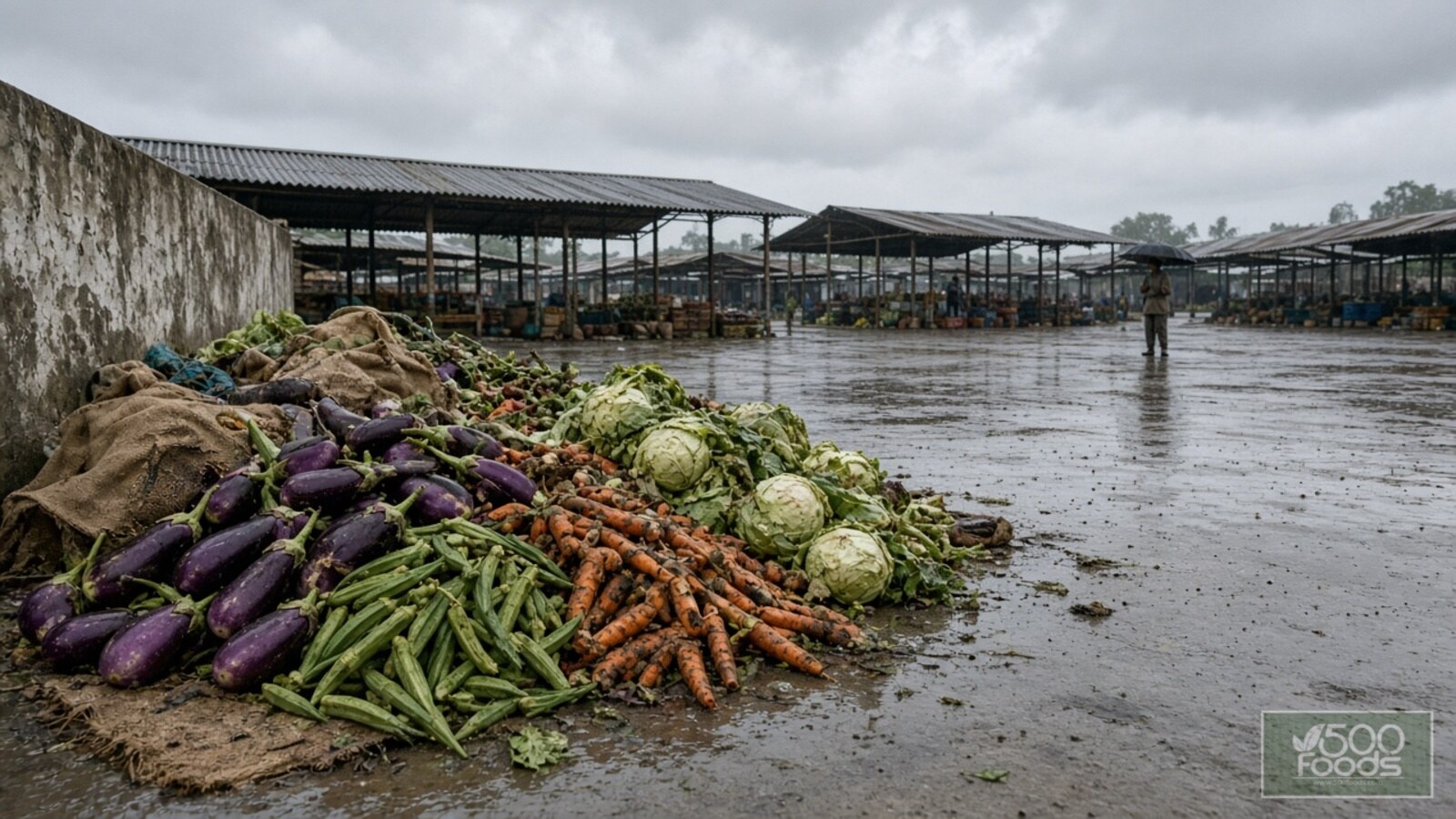
Nearly 2,000 tonnes of vegetables, roughly a fifth of a normal day's arrivals, were dumped at Chennai's Koyambedu wholesale market after the Ayudha Pooja holidays and persistent rain kept buyers away. Wholesale prices for most vegetables slipped by about Rs 5 per kilogram between 16 and 20 October, and carrots fell by about Rs 10.
Koyambedu, on the western side of Chennai, is one of the largest perishable-produce hubs in South Asia. According to the Koyambedu Semi-Wholesale Vegetable Traders Association, around 10,000 tonnes of vegetables arrive there every day from across Tamil Nadu and neighbouring states. In the days around Ayudha Pooja and Vijayadasami this October, much of that supply had nowhere to go. Traders told DT Next that more than 2,000 tonnes, chiefly brinjal (eggplant), okra and carrots, had rotted and been discarded, and that conditions had not improved by Tuesday.
Why the buyers stayed home
Several pressures converged. Many city residents had left for their home towns for the long festival weekend, and the retailers, hotels and caterers who normally buy in bulk scaled back. Intermittent rain compounded the problem: produce that is soaked in open-air stalls loses firmness and appearance within hours, so stock that might have kept for another day became unsaleable. Speaking to the Times of India, the vendors' association president, S. Muthu Kumar, also blamed the relocation of southbound bus services to the Kilambakkam terminus, which removed a stream of travellers who once shopped at the market before boarding. He added that more households now order groceries online rather than visiting in person.
Prices moved, but not enough
Cutting prices did little to clear the backlog. Onions held steady at Rs 58 per kilogram, while okra traded at about Rs 15, brinjal at Rs 25 and cabbage at Rs 10. At those levels, the cost of transport, loading and stall space can exceed the value of the produce itself, and once quality deteriorates, dumping becomes the cheapest option. Consumers benefit briefly from lower prices, but the growers who supplied the market absorb most of the loss.
A structural problem, not a one-off
Episodes like this are a visible spike in a chronic, often unseen loss. A national study commissioned by India's Ministry of Food Processing Industries and carried out by NABARD Consultancy Services estimated that 4.87 to 11.61 per cent of vegetables are lost between harvest and sale, about 12 million tonnes in 2020–21. It identified poor handling, inadequate storage and an immature cold chain as the main causes. Government programmes now fund cold rooms, ripening chambers and pack houses, yet a wholesale yard that depends on open stalls and same-day sales remains exposed whenever demand dips or the weather turns.
For growers and marketers elsewhere, the lesson is familiar: perishables need a buffer. Short-term cold storage, flexible routing to processors, and better demand signals ahead of holidays can turn a glut into a discount rather than a dumpster.
References:
- Sharp dip in prices: 2,000 tonnes of veggies dumped at Chennai's Koyambedu market, DT Next (21 October 2026)
- Unsold vegetables pile up at Koyambedu market as festival trade slows, Times of India (20 October 2026)
- Study to Determine Post-Harvest Losses of Agri Produces in India, NABCONS for the Ministry of Food Processing Industries (2022)
- Schemes to minimise post-harvest losses, Press Information Bureau, Government of India (25 July 2025)
How we find, write and illustrate these stories, and how you can share them: see Welcome to Ag Articles.
AI-generated post text and image content are shared under CC BY 4.0.