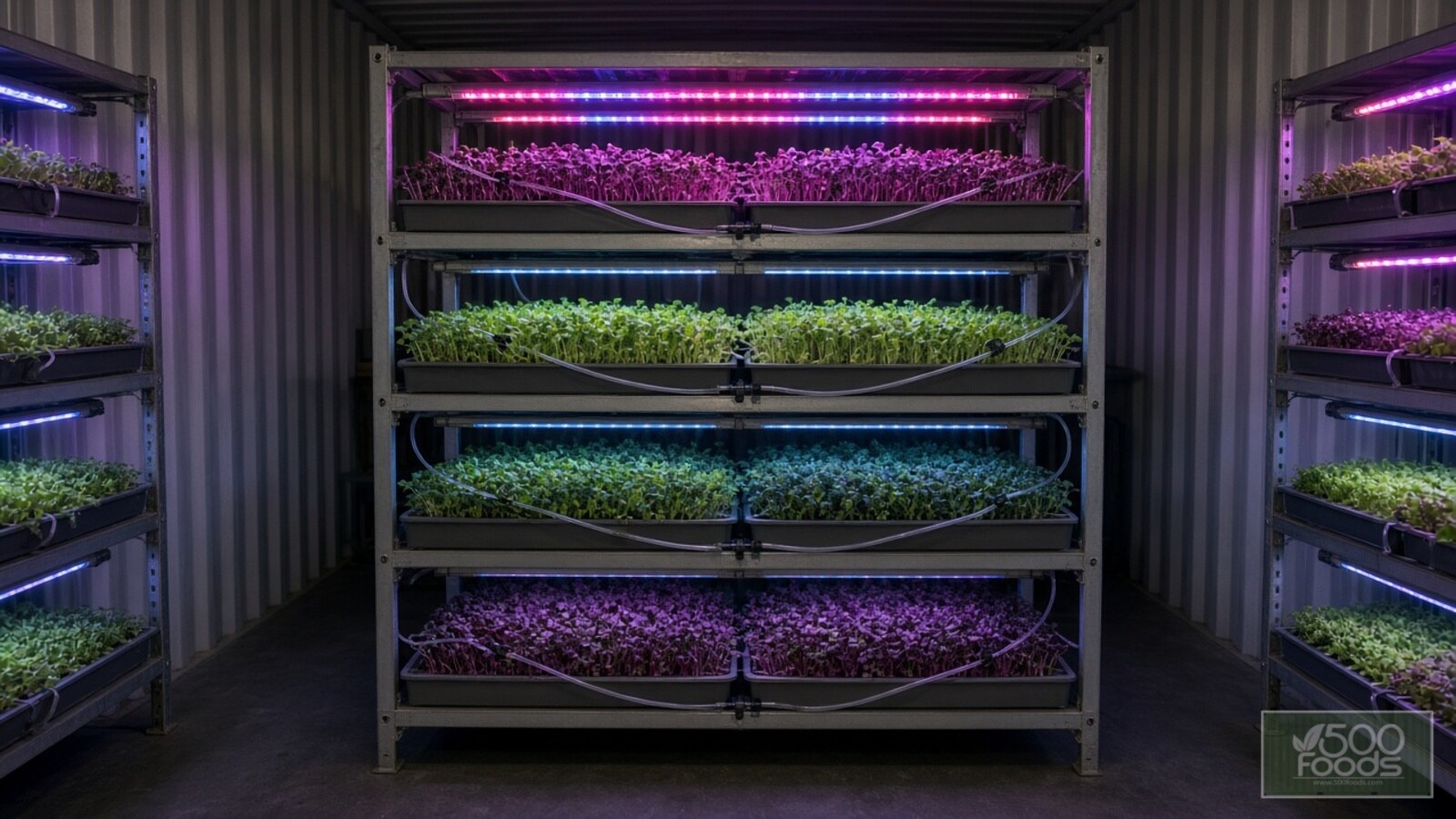
Microgreens already carry a reputation as small, dense packages of nutrition. A plant science team at Penn State now argues that indoor growers can push that further with three ordinary tools: the fertiliser in the irrigation water, the colour of the LEDs, and the water itself. The group, led by Francesco Di Gioia, published three studies this autumn, each tied to a choice indoor growers make every week.
Iron in the irrigation line
The first study, led by doctoral candidate Rishi Ravichandran, compared five iron sources fed to radish and pea microgreens through the water at 0, 15, 30 and 45 mg per litre. Fe-EDTA, a chelated form, worked best. It raised iron content three to five times in radish and two to three times in pea compared with plants that got no added iron, and it did so with only small trade-offs in yield and other minerals.
That matters because iron is hard to feed well. Plants struggle to take it up in alkaline water, and too much can crowd out other minerals or harm the crop. For a grower, the useful lesson is that the form of iron counts as much as the dose. Iron deficiency is common worldwide, so a crop that is easy to enrich could be a real selling point.
Changing the light recipe
The second study, led by Aline Novaski Seffrin, grew radish and broccoli microgreens under six LED settings at about 163 µmol per square metre per second for 14 hours a day. That works out to a daily light integral of about 8.2 moles, which is close to what many commercial microgreen rooms use.
The results did not crown a single winner. Pure blue light gave the tallest shoots but the least dry mass. It also gave the highest antioxidant activity, about 16% higher averaged across both crops, and about 19.5% higher than pure red. Mixed red and blue light kept shoots shorter and raised total nitrogen. In broccoli, the 75:25 and 25:75 red-to-blue mixes lifted iron by 15 to 20% over pure red, pure blue or white light. Radish iron did not change. Fresh yield stayed about the same across every setting.
For indoor farms with tunable fixtures, this suggests a recipe built around the goal, not one spectrum for every tray.
Water treated with artificial lightning
The third study, led by Sanchita Saha, tested plasma-activated water on pea microgreens. The water is made by sparking electrical discharges in air over water, which dissolves nitrogen and oxygen compounds into it. Used fresh, 30 to 90 minutes of treatment raised yield by 5 to 13%, while 120 minutes hurt yield. Storing the water for 72 hours raised its nitrate level. The best mix, 60 minutes of treatment and 72 hours of storage, increased biomass by 19.7% and water-use efficiency by 21.5%. It also raised calcium and magnesium.
What it means for container growers
All three trials ran in small trays inside a growth chamber, so the numbers are a starting point, not a promise. Still, each lever fits a sealed container or stacked rack well. Dosing lines, tunable LEDs and closed water loops are already part of the setup. A plasma unit is new equipment, though, and its power cost needs real testing before anyone buys one. The cheapest step to try first is the iron source.
References:
- Speciation-Dependent Iron Uptake Drives Biofortification Efficiency and Nutritional Quality in Radish and Pea Microgreens, Ravichandran and Di Gioia, Biological Trace Element Research (2026)
- Red:Blue LED Ratio Modulates Growth and Nutritional Quality of Brassica Microgreens Under Low Daily Light Integral, Novaski Seffrin and Di Gioia, Horticulturae 12(10) 1210 (2026)
- Plasma-activated water processing and storage time impacts pea microgreens yield and quality, Saha and Di Gioia, Journal of the Science of Food and Agriculture (2026)
How we find, write and illustrate these stories, and how you can share them: see Welcome to Container Culture.
AI-generated post text and image content are shared under CC BY 4.0.