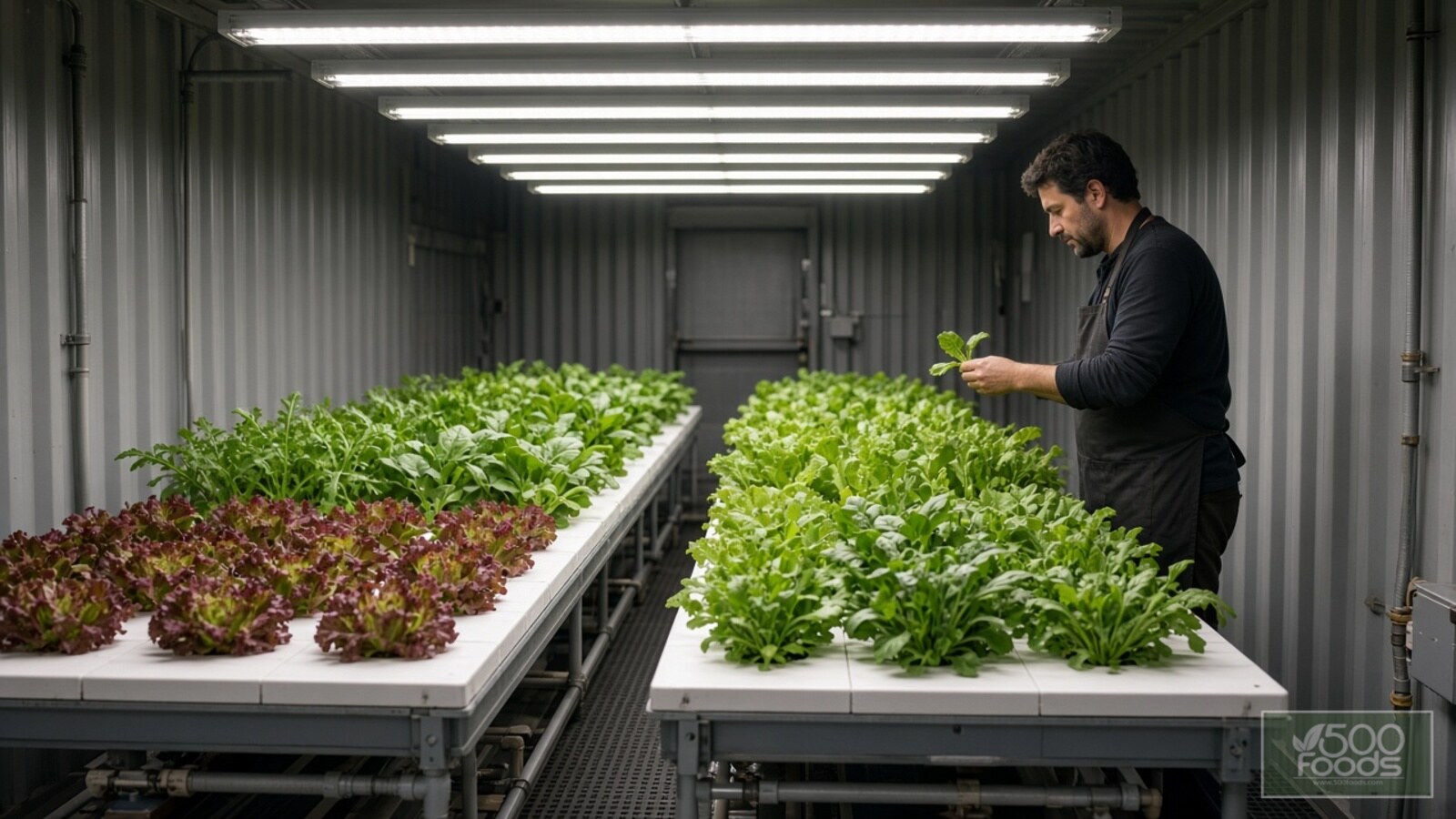
Leafy greens may do most of their useful growing in the last week before harvest, at least when growers give them a strong burst of extra light. A new HortScience study from the University of Tennessee tested this idea, called end-of-production lighting, on four hydroponic crops. The results matter to container and vertical farms, where every photon is paid for on the power bill.
Researchers grew red butter lettuce, arugula, spinach and mustard greens on floating rafts in a Knoxville greenhouse. The plants already received a modest background of about 9 moles of light per square metre each day. Then, 1, 3 or 7 days before harvest, the team switched on extra LED fixtures at roughly 100, 200, 400 or 600 µmol·m⁻²·s⁻¹. Most treatments used broad-spectrum white light, while one compared a red-blue mix at about 200. After harvest, plants were stored in clamshells in a dark cooler near 4 °C and scored for appearance for up to five weeks.
A week of strong light paid off
The strongest treatment, about 600 µmol·m⁻²·s⁻¹ for seven days, produced the heaviest plants in every crop. Compared with unlit controls, arugula gained 87% in fresh mass, mustard greens 77% and spinach 42%, which was about 26 grams more per plant. Three days at the same intensity also helped, adding 52% to arugula and 45% to mustard greens. Lettuce responded to the extra light over 3 and 7 days as well, although the paper gives no single headline figure for it.
One day was not enough. With only 24 hours of extra light, fresh mass barely moved, and chlorophyll fluorescence readings showed the plants were under stress. Over 3 to 7 days, those readings recovered, which suggests the leaves adjusted to the brighter conditions and turned the extra photons into growth. Broad-spectrum light also beat red-blue light for arugula and mustard greens after a week, by 17% and 16% respectively.
Shelf life mostly stayed the same
Extra light did not make most greens last longer. Lettuce, spinach and mustard greens looked about the same in storage whatever their treatment, and late improvements arrived only after the greens were already past a marketable grade. Arugula was the exception: longer lighting improved its appearance one week after harvest.
What it means for container farms
For growers using shipping containers or indoor racks, the key question is cost. A rough estimate helps. If LEDs deliver about 2.9 µmol per joule, a common figure for efficient fixtures, then 600 µmol·m⁻²·s⁻¹ draws roughly 200 watts per square metre. Run for 16 hours, that is about 3.3 kWh per square metre each day, or around 23 kWh over a week. At $0.15 per kWh, a week of finishing light would cost about $3.50 per square metre of canopy. Whether that pays depends on plant density and crop price, but an 87% gain in arugula leaves a lot of room.
There are important caveats. This was a greenhouse trial with low natural light, so the extra lamps filled a real gap. Many container farms already run their LEDs at high intensity, so they may see smaller gains. Cooling is another hidden cost, because every watt of light becomes heat that a sealed container must remove. Even so, the study points to a practical plan: keep lights moderate for most of the crop cycle, then raise them for the final three to seven days, rather than running them at full power from seed to sale.
References:
- End-of-Production Lighting Effects on the Growth, Morphology, and Postharvest Longevity of Greenhouse-Grown Leafy Greens, Friedrich, Armstrong and Walters, HortScience 61(11) (2026)
- High light intensity applied shortly before harvest improves lettuce nutritional quality and extends the shelf life, Min et al., Frontiers in Plant Science (2021)
- Review of energy efficiency in controlled environment agriculture, Engler and Krarti, Renewable and Sustainable Energy Reviews (2021)
How we find, write and illustrate these stories, and how you can share them: see Welcome to Container Culture.
AI-generated post text and image content are shared under CC BY 4.0.