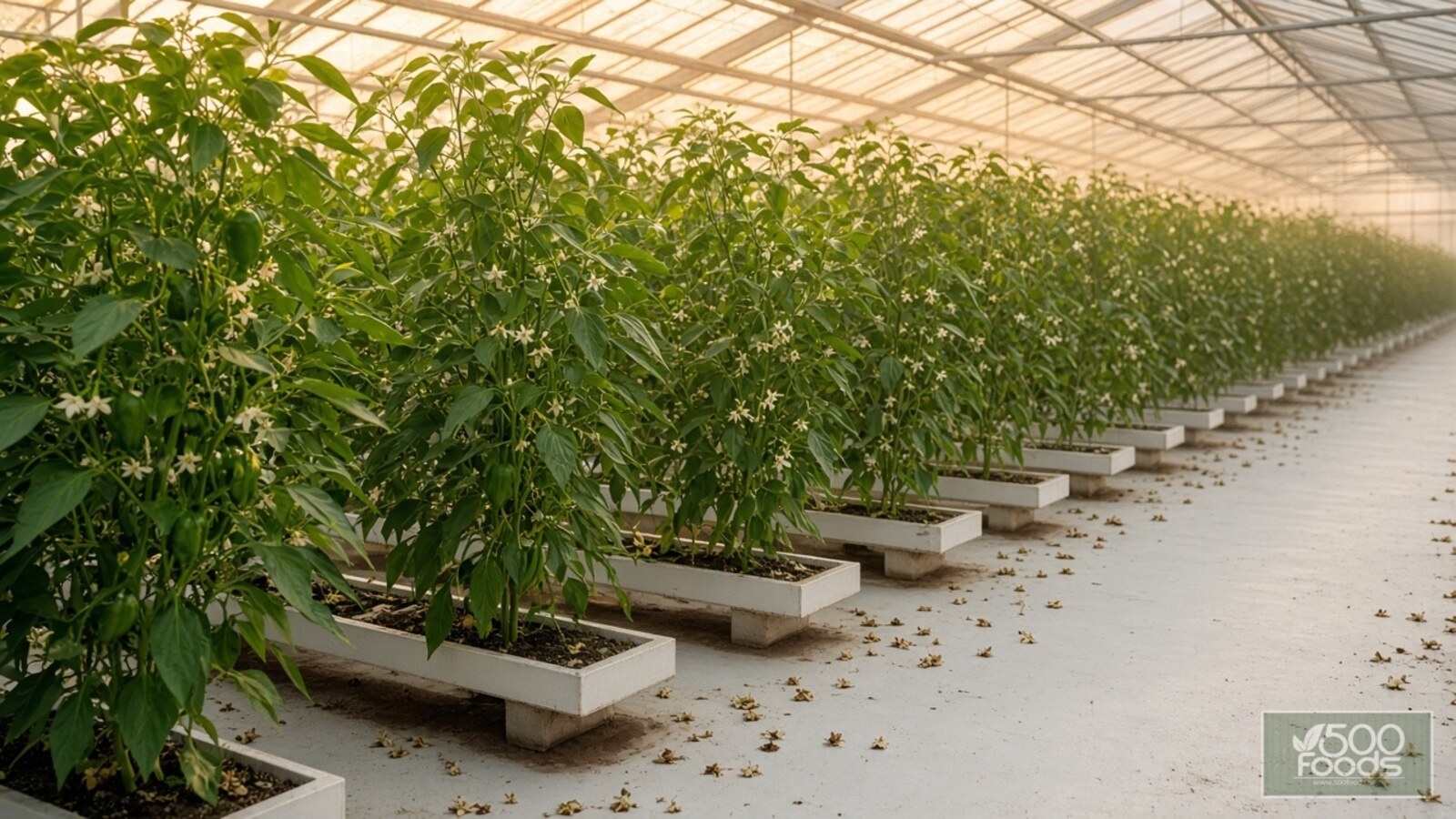
Japanese researchers found that sweet pepper plants drop far more flowers when greenhouse temperatures run even mildly hot, and that extra photosynthate does not make up for it. At an 8 g·g⁻¹ source–sink ratio, fruit set fell from about 0.5 to 0.2 fruits per flower when it was hotter than 22 °C.
Anyone who grows sweet peppers under glass knows the frustration of flowers that open, look healthy, and then fall off without setting fruit. Growers usually manage this flower abortion by balancing the plant's "source" (the leaves making sugars) against its "sink" (the fruits already competing for them). A new study from Japan's National Agriculture and Food Research Organization (NARO), highlighted by HortiDaily, shows that temperature can override that balance even when the plant has plenty of sugar to spare.
What the team measured
Masaru Homma, Tadahisa Higashide and Masahide Isozaki grew the red sweet pepper cultivar Artega hydroponically in a climate-controlled greenhouse at NARO's Institute of Vegetable and Floriculture Science in Tsukuba. They ran three crops lasting 206, 131 and 120 days, and the daily average temperatures ranged from an optimal 19 °C to a mildly stressful 30 °C.
For each tagged flower they calculated the source–sink ratio (SSR), which compares how much assimilate the plant was producing with how much its fruits were drawing. They also recorded the average air temperature over the first week after the flower opened. Then they checked which flowers went on to set fruit.
What they found
- More supply helps, up to a point. Across all trials, fruit set rose as the SSR rose, which confirms the usual crop-steering logic.
- Heat flattens the curve. When it was warmer than about 22 °C in the week after flowering, the same SSR produced far fewer fruits. At an SSR of 8 g·g⁻¹, fruit set was roughly 0.5 fruits per flower in the optimal range but only about 0.2 under mild heat.
- Not a sugar shortage. Because abortion rose even with ample assimilates, the authors conclude that mild heat stress itself drives flower loss, independent of photosynthate supply.
Why it matters for growers and buyers
Many pepper greenhouses steer fruit load by pruning, adjusting stem density or boosting light and CO₂ to raise the source side. This work suggests those levers lose much of their effect once the week after flowering turns warm. In warm summers, cooling, shading, fogging and night-temperature control may do more for fruit set than extra assimilates.
For the supply chain, it helps explain the uneven pepper flushes that follow heat waves. A hot spell can thin the next harvest weeks later, even in a well-run crop. As summers warm, the study also points breeders toward heat-tolerant flowering as a trait worth selecting for, and points climate-control systems toward the critical days just after anthesis.
References:
- Mild Heat Stress Accelerates Flower Abortion in Sweet Pepper (Capsicum annuum L.) Independent of the Photosynthate Supply, Homma, Higashide & Isozaki, Journal of the American Society for Horticultural Science 151(6): 555–567 (2026)
How we find, write and illustrate these stories, and how you can share them: see Welcome to Ag Articles. Text and AI-generated images are shared under CC BY 4.0.