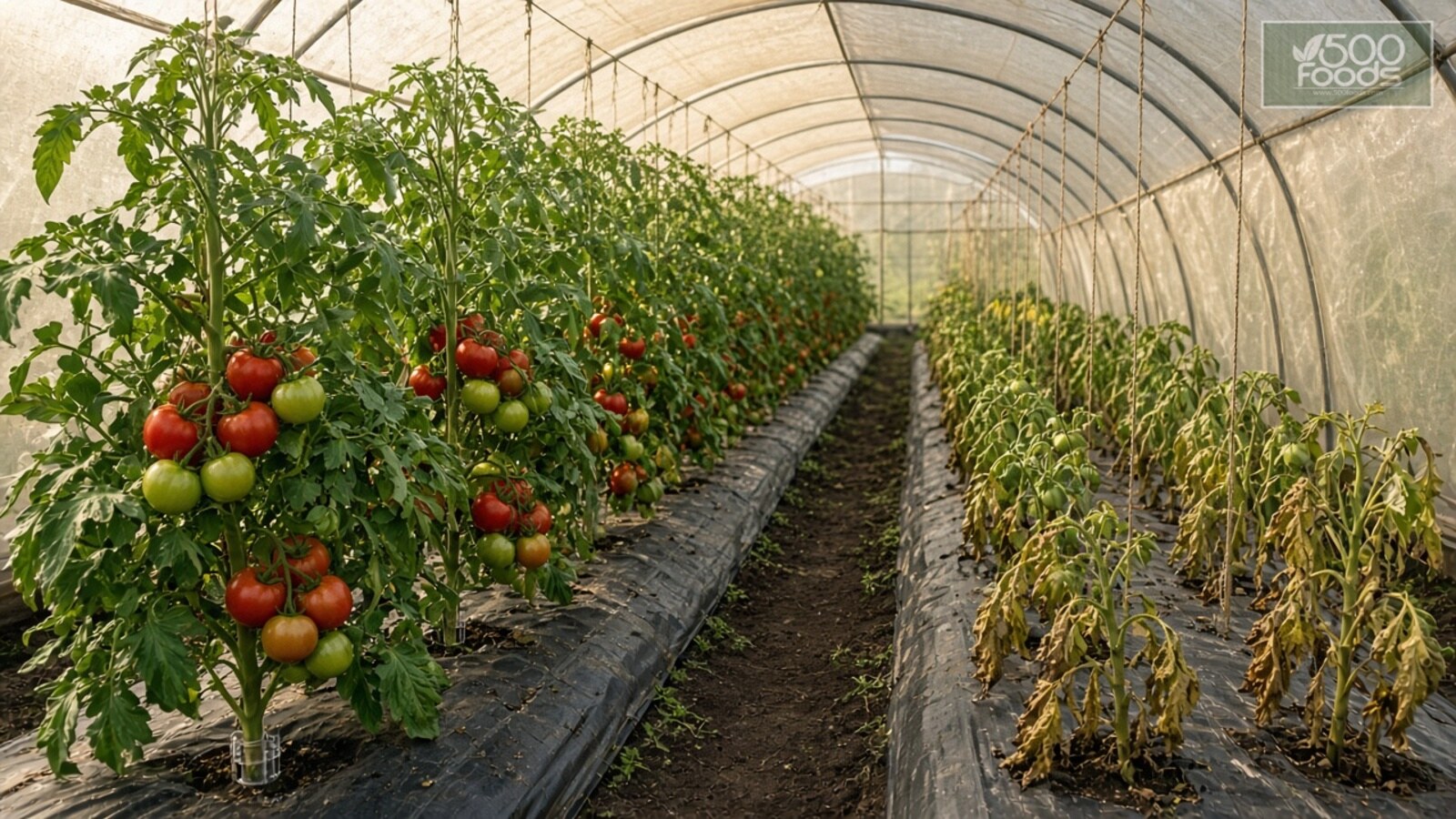
Bacterial wilt is the kind of disease that makes growers give up on a field. Once Ralstonia solanacearum settles into the soil, it can persist for years, and there is no spray that cures an infected tomato plant. A new trial from Paraguay tested one of the few practical answers, grafting, in exactly the setting where it is needed most: a plastic house that had grown tomatoes for about fifteen years in a row and had shown wilt every season for the last five.
The trial
Researchers at the Universidad Nacional de Asunción's horticultural centre in San Lorenzo grew two commercial hybrids, Ravena and Grazianni, both on their own roots and grafted onto Sakata's Woodstock rootstock, which the seed company lists as highly resistant to bacterial wilt as well as Verticillium, Fusarium races 1 and 2 and root-knot nematodes. The plants went in on 3 June 2022 and were picked twelve times from September to mid-November. Nobody added the pathogen; the disease pressure was whatever the old soil already carried.
Grafting was the simple splice method: matching 45-degree cuts on scion and rootstock, held with a small plastic clip, then a week healing in a dark, humid chamber. Graft take was 90% for Ravena and 92% for Grazianni.
What happened
The disease result was stark. All 60 ungrafted Ravena plants and 52 of 60 ungrafted Grazianni plants (86.7%) developed wilt. Not one grafted plant of either variety showed symptoms.
Yield followed. Grafted plants averaged about 29.6 fruits each against 24.9 on their own roots, roughly 19% more, and the fruit was heavier (about 104 g versus 95 g). Grafted Grazianni topped the trial at about 3.2 kg of fruit per plant, while ungrafted Ravena managed 2.1 kg. Marketable yield rose with grafting too, though the share of fruit that made the grade rose for Grazianni and dipped slightly for Ravena.
Read it carefully
The authors are candid about limits. It was one site, one season, one rootstock and two varieties. Soil pathogen levels were never measured, so a clean grafted row is evidence of protection under this pressure, not formal proof of resistance. There was no cost analysis, and grafted transplants cost more than seed-grown ones.
Why it matters beyond Paraguay
Bacterial wilt thrives in warm, wet conditions and also attacks peppers, eggplant and potatoes, so rotating within the nightshade family does little to starve it out. That leaves few tools besides resistant roots.
For organic and small-scale growers, the appeal is that grafting is a cultural control rather than a chemical one. It lets you keep a favourite fruiting variety while borrowing a tough root system, and it works in tunnels and open fields where long rotations are hard to manage. If wilt, Fusarium or nematodes keep returning to your tomato ground, a short trial is cheap to run: graft (or buy grafted plants on a rootstock rated for your problem), plant them beside your usual transplants, and count the plants still standing at harvest. Home splice grafting needs little more than a sharp blade, clips and a dark, humid spot for a week. Clean sanitation and rotation still matter; a resistant root only buys time if the pathogen keeps building up.
References:
- Impact of grafting on yield and plant health of tomato varieties cultivated under protected subtropical climate, Frontiers in Horticulture (2026)
How we find, write and illustrate these stories, and how you can share them: see Welcome to Better Than Organic.
AI-generated post text and image content are shared under CC BY 4.0.