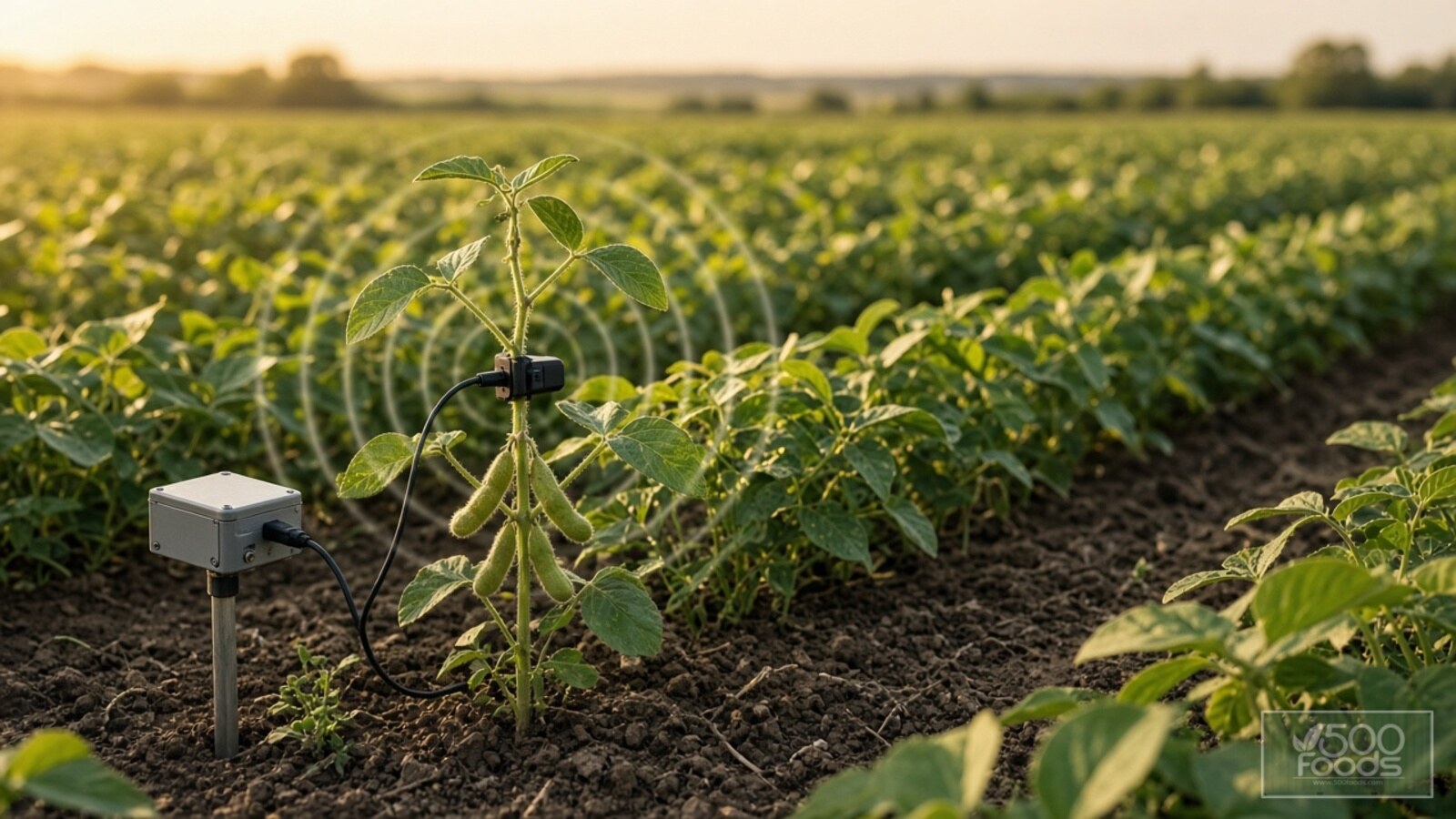
Researchers at Kansas State University are clipping contact microphones to soybean stems to detect stem borers that feed out of sight. The device, called the Insect Eavesdropper, records plant vibrations that people cannot hear and uses machine learning to flag insect feeding before damage becomes visible.
Most pest monitoring still depends on what a scout can see: chewed leaves, frass, adult moths on a sticky card. The pests that hurt yields most are often the ones that do not show themselves. Larvae bore inside stems, rootworms feed below the soil line, and many insects are active at night. By the time the injury is visible, the most effective window for control has often closed.
How the Eavesdropper works
The Insect Eavesdropper was developed by entomologist Emily Bick and computer scientist Dev Mehrotra at the University of Wisconsin–Madison. A piezoelectric contact microphone is clipped to a stem and wired to a Raspberry Pi single-board computer, which records the faint vibrations that chewing and boring transmit through plant tissue. Software isolates individual feeding events and passes them to a classifier trained to recognise the vibrational signatures of particular species.
In a preprint describing the early work, the Wisconsin team detected feeding by tobacco hornworm, Colorado potato beetle, European corn borer and northern corn rootworm, both in the laboratory and in a corn field, where background noise turned out to be lower than expected. The recordings also showed that species differ in the rhythm, frequency and amplitude of their feeding. Bick has reported species-identification accuracy of roughly 80% to 96% in laboratory tests. The lab has since shared the hardware with other institutions, and a companion paper says the device has been evaluated on 27 insect species across 17 cropping systems.
Testing it on a hidden soybean pest
At Kansas State, master's student Emily Sur and Brian McCornack, head of the entomology department, have deployed the microphones on soybean plants this summer, targeting Dectes texanus, the soybean stem borer. The larva tunnels inside the stem and normally can only be confirmed by cutting plants open. The team records for several days, then dissects the plants to check which ones were infested, building the labelled data the classifier needs. Similar trials are running in greenhouse cotton.
Promise and limits
For growers and crop advisers, continuous acoustic monitoring could provide earlier, plant-level evidence of pest pressure, allowing better-timed and more targeted sprays instead of calendar applications. Because the hardware is inexpensive, a network of sentinel plants across a farm is conceivable, and a handheld version could serve as a non-destructive scouting tool.
Several questions remain open, however. Peer-reviewed evidence is still thin, since the core validation study is a preprint, and field accuracy across mixed pest communities, wind and machinery noise has not yet been reported. Wiring individual plants also raises questions of cost and maintenance at field scale. McCornack is careful to describe the tool as a complement to scouting, not a replacement: its value lies in signalling change so that someone takes a closer look. For high-value crops with hidden borers, from sugarcane to vegetables, that alone could prove useful.
References:
- Eavesdropping on Herbivores: Using contact microphones to quantify Plant-Insect Interactions, Mehrotra, Still, Agrawal, Gibson, Crall & Bick, bioRxiv preprint (2024)
- BickGraphing: Web-Based Application for Visual Inspection of Audio Recordings, Journal of Open Research Software
- The Insect Eavesdropper, Grow magazine, University of Wisconsin–Madison CALS
- Insect Eavesdropper project site, Bick Lab, University of Wisconsin–Madison
How we find, write and illustrate these stories, and how you can share them: see Welcome to Ag Articles.
AI-generated post text and image content are shared under CC BY 4.0.