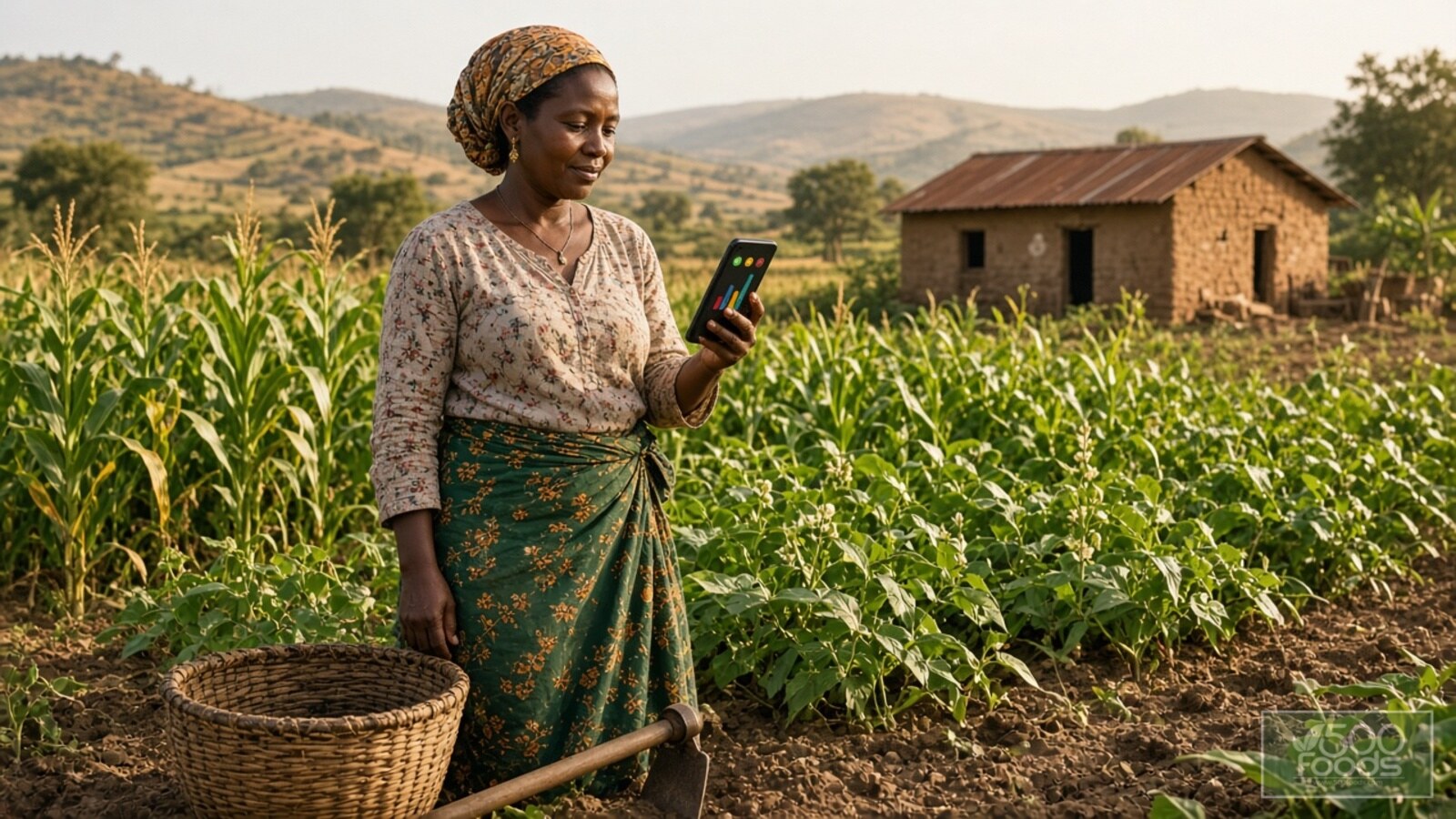
Digital advisories and AI tools only help women farmers if they can afford them and control the money they generate, argues the head of the World Bank-hosted Global Agriculture and Food Security Program. Trials in Ethiopia and Uganda suggest that changing how loans are appraised and paid out matters as much as access to technology.
In an interview with SciDev.Net, republished by Phys.org, Shobha Shetty, who leads the Global Agriculture and Food Security Program (GAFSP), warned that development projects too often count women as beneficiaries without asking whether their lives change. Her remarks coincided with a new CGIAR report, Advancing equality, transforming futures, released on 15 October for the International Day of Rural Women. It finds that women make up 38% of the agricultural labour force in low- and middle-income countries, and 41% of the off-farm agrifood workforce, yet still face systematic barriers to land, water, credit and decision-making.
Access is not the same as benefit
Smallholders are under pressure from higher fertilizer prices, a strong El Niño and deep cuts to overseas aid. AI-powered weather and pest advisories could help, but Shetty argues that reach is only a starting point. The relevant questions are whether women can pay for these services, influence how they are designed, and keep the value they create. The CGIAR report makes a similar case, devoting a chapter to digital inclusion and arguing that solutions should be co-designed with women and financed in ways that match their circumstances.
What the finance evidence shows
- Collateral-free loans in Ethiopia. In a randomized trial run with the World Bank's Africa Gender Innovation Lab, a microfinance institution appraised women entrepreneurs using psychometric testing instead of collateral, which many women lack. Over three years, 89% of women offered the loan borrowed formally, against 42% in the control group, and three-year firm survival rose from 67% to 83% despite COVID-19 and conflict.
- Mobile money in Uganda. In a trial with 3,000 BRAC borrowers in Kampala, women whose loans were paid into a mobile money account earned 15% higher business profits after eight months than those paid in cash. Simply giving women an account, while still disbursing cash, had little effect, because cash is harder to protect from household demands.
A caveat is worth noting: both studies involved small-business owners, many of them urban, rather than farmers specifically. The mechanisms of collateral-free appraisal and private, controllable payment channels are plausible for agriculture, but they have not yet been tested at scale on farms.
Why it matters for smaller farms
For independent and family farms anywhere, the lesson is practical. A new tool pays off only when financing matches the farm's cash flow and the person doing the work controls the proceeds. Shetty's prescription, linking better information with affordable products, repayment schedules aligned with harvests and payment channels women control, reads like sound farm finance in general. GAFSP reports that 41% of its beneficiaries are women across nearly US$2.5 billion of investment since 2010, and is now using grant funding to reduce lenders' risk and draw private capital into small agricultural businesses in eastern and southern Africa and in Rwanda. Whether those blended-finance deals deliver for women farmers, rather than simply counting them, will be the real test.
References:
- Advancing equality, transforming futures: a path to resilient and productive food, land and water systems in 2050, Lecoutere, Muchiri & Voss (eds.), CGIAR GENDER Accelerator (2026)
- Evening the Credit Score? Impact of Psychometric Loan Appraisal for Women Entrepreneurs, World Bank Policy Research Working Paper 10230
- Resisting Social Pressure in the Household Using Mobile Money: Experimental Evidence on Microenterprise Investment in Uganda, Emma Riley, American Economic Review 114(5): 1415–1447 (2024)
How we find, write and illustrate these stories, and how you can share them: see Welcome to Better Than Organic.
AI-generated post text and image content are shared under CC BY 4.0.