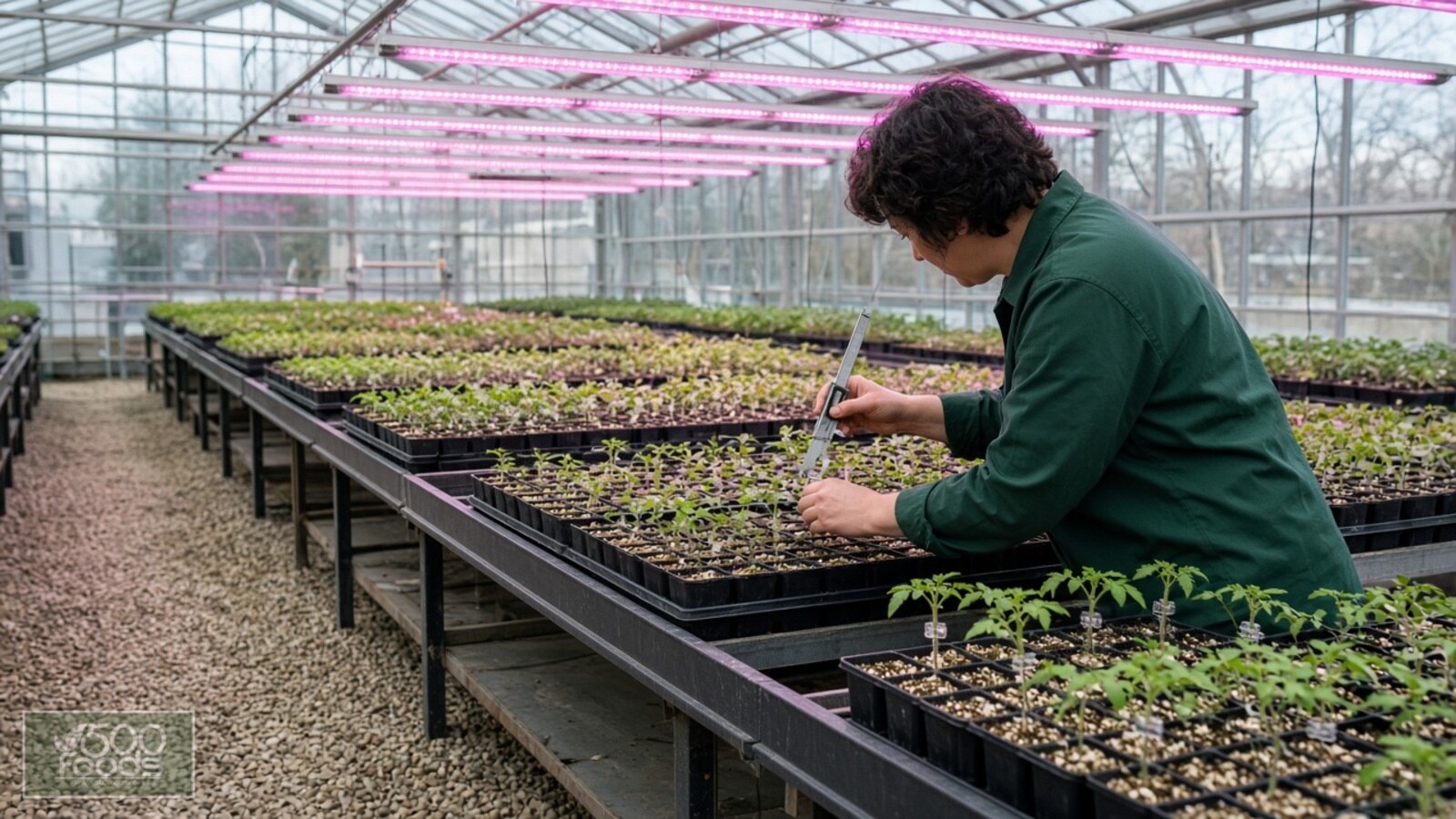
In mid- to low-tech greenhouses, tomato propagation often starts in late February, when daylight is still short and many growers cannot justify a full supplemental-lighting build. A HortScience paper from the University of Kentucky, published 23 November 2026, asks a practical question: if you can add only a modest amount of LED light, does a stronger nutrient solution still improve seedlings and grafted transplants?
A 2 × 2 trial in a Lexington greenhouse
Arundathi Sharma and Qinglu Ying, in the Department of Horticulture at the Martin-Gatton College of Agriculture, Food and Environment, ran the work from 24 February to 17 April 2025 in the university's Horticulture Research Greenhouse. High light added 138.2 ± 5.1 µmol·m⁻²·s⁻¹ of photosynthetic photon flux; low light added 46.2 ± 3.6 µmol·m⁻²·s⁻¹. LED fixtures ran a 17-hour photoperiod from 10 days after sowing, adding about 8.5 and 2.8 mol·m⁻²·d⁻¹ of daily light integral (DLI) on top of ambient greenhouse light, which already averaged 15.3 mol·m⁻²·d⁻¹ during seedling production and 16.2 after grafting.
The high-nutrient solution was a complete 17-5-17 fertilizer mixed to a target electrical conductivity (EC) of 2.4 mS·cm⁻¹ and about 200 ppm nitrogen. The low-nutrient solution targeted EC 1.2 mS·cm⁻¹ and about 80 ppm nitrogen. Four cultivars were grown in 72-cell trays of peat–perlite mix: the rootstock ‘Maxifort’ and the scions ‘Estiva’ (tomato-on-the-vine), ‘Marnero’ (beefsteak) and ‘Favorita’ (cherry). At 22 days after sowing, when stems were about 2.2 mm, ‘Marnero’ and ‘Favorita’ were splice-grafted onto ‘Maxifort’. Plants healed in darkness at 25 °C for three days, then returned to their treatments and were measured again at 52 days after sowing, 23 days after healing.
Nutrients mattered first; high light and high nutrients won later
Early on, nutrient strength moved stem diameter more than light did. By 22 days after sowing, high-nutrient plants of all four cultivars had thicker stems than their low-nutrient counterparts, by 16.4% in ‘Maxifort’, 33.3% in ‘Estiva’, 13.3% in ‘Favorita’ and 10.1% in ‘Marnero’. Compared with the low light–low nutrient (LL) treatment, the high light–high nutrient (HH) treatment thickened stems by 18.8% to 49.7%. High light also shortened ‘Maxifort’ and ‘Marnero’ seedlings, by 12.8% and 23.5%. The authors estimated that HH plants would reach a graftable diameter about one to four days earlier than the other treatments. One hitch: ‘Estiva’ under high light and low nutrients could not be grafted because stem diameters did not match, so that combination was dropped from the postgrafting data.
After grafting, plant height, stem diameter and leaf number changed little, but biomass did. Relative to LL, HH raised aboveground fresh weight by 49.0% to 53.1% and dry weight by 63.6% to 86.9%. ‘Marnero’ under HH also had 76.6% more shoot fresh weight than high light with low nutrients, and 116.7% more root dry weight than LL. Chlorophyll content index rose with both high light (38.9% to 40.1%) and high nutrients (23.6% to 31.9%).
What this means in a container
A useful caution for indoor and container growers: even the “low light” treatment in this greenhouse still sat at a total DLI of about 18.1 to 19.0 mol·m⁻²·d⁻¹ once daylight was included, already above the commonly cited tomato-seedling target of about 13 mol·m⁻²·d⁻¹. In a sealed container, 46 µmol·m⁻²·s⁻¹ for 17 hours would supply only about 2.8 mol·m⁻²·d⁻¹. The paper's own conclusion is still practical where light is constrained: a full-strength, balanced solution at EC 2.4 remained useful even at the lower supplemental level, and the HH combination was the most reliable way to gain stem thickness, chlorophyll and biomass. The authors did not follow the plants through to fruit, so yield effects remain an open question.
References:
- Sharma A, Ying Q (2026). Effect of Light Intensity and Nutrient Concentration on Tomato Seedling and Grafted Transplant Production. HortScience 61(12):2744–2750. https://doi.org/10.21273/hortsci19688-26
How we find, write and illustrate these stories, and how you can share them: see Welcome to Container Culture.
AI-generated post text and image content are shared under CC BY 4.0.