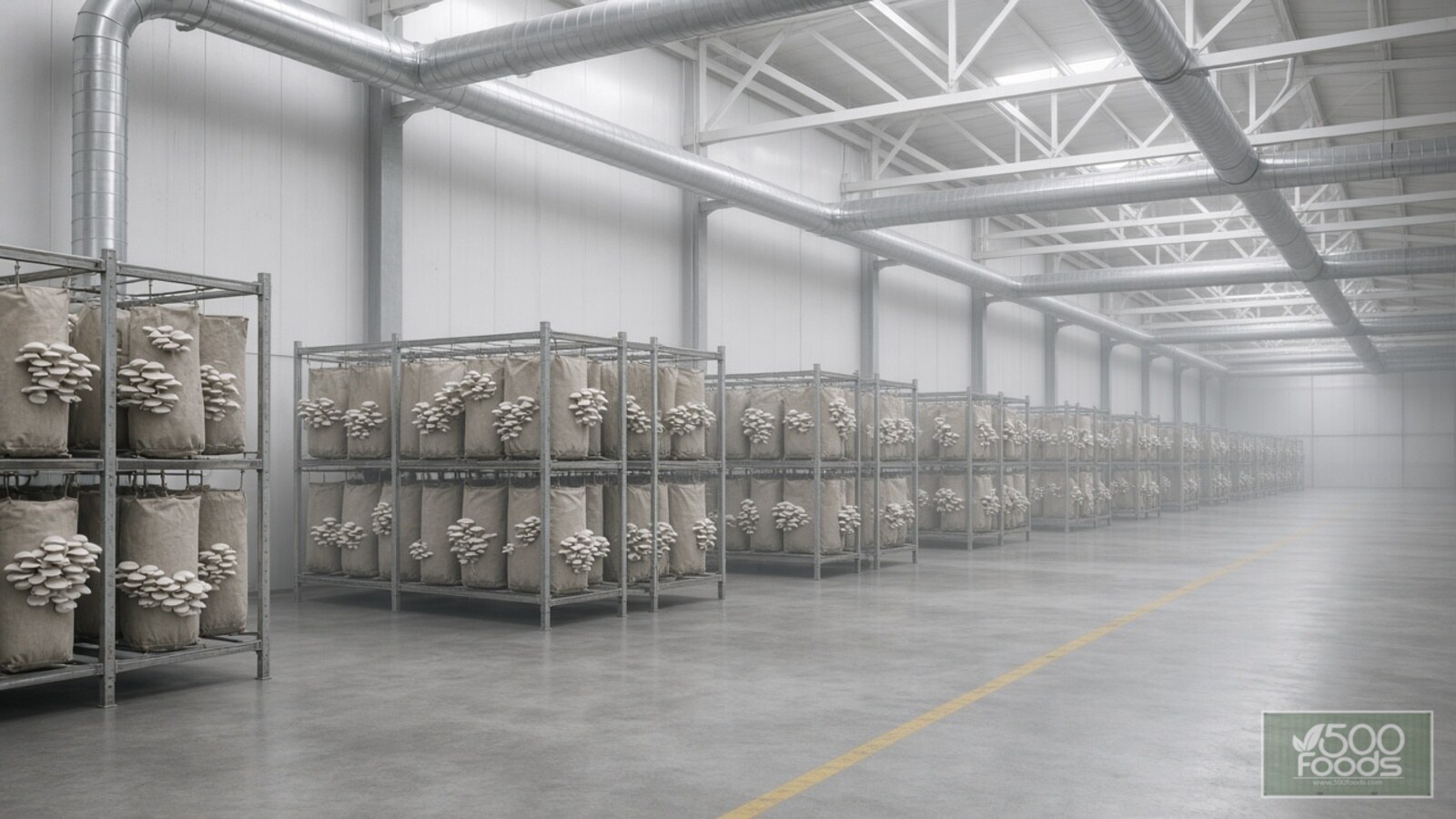
When Holden built its last Commodore in Elizabeth, north of Adelaide, in October 2017, it left behind one of the largest industrial sites in South Australia. In early 2023 part of it found an unusual second life. Epicurean Food Group moved exotic mushroom production into the old vehicle paint plant, and Vertical Farm Daily has now revisited the story as an example of a car factory turned into an indoor farm. The idea is still worth a close look. So is what happened next.
Why a paint shop suits mushrooms
Mushrooms need no sunlight. They do need tight control of humidity, temperature, carbon dioxide and airflow, and they need it every hour of the year. A car paint shop is built around much the same problem. It is a set of sealed, windowless bays with heavy ventilation, filtered air and large power supplies, because paint finishing is ruined by dust and changing conditions. Starting inside that kind of shell is closer to a working grow room than an empty farm shed or a bare paddock.
The first stage used about 4,000 square metres in the former Lionsgate building, with six grow rooms each about 20 metres long and 6 metres high. Chief executive Kenneth King told the ABC the company would start with white oyster mushrooms, then add shiitake, enoki and king oyster. The plan described by the South Australian government was far bigger: a $110 million, 35,000 square metre site, growing columns up to 13 metres high, more than 20,000 tonnes of mushrooms and mushroom products a year, and about 350 jobs. It also aimed to cut Australia's reliance on imports, which supply about 85% of the country's exotic mushrooms.
What happened next
The building worked better than the business. By mid-2023 three rooms were in full production and fresh oysters were on the shelves of 45 Drakes stores. That July, a fatal mushroom poisoning case in Victoria made national headlines and mushroom sales fell sharply. The company's sales arm, Epicurean Distribution, went into court liquidation in November 2023 with debts of close to $5 million. In July 2026 Australia Post broke ground on an 83,000 square metre parcel hub on the old Holden site, due to open in late 2028.
Lessons for container and vertical growers
The site itself was never the weak point. Reusing a sealed industrial building can save years of construction and a large share of the cost of air handling and power. The harder parts were the same ones that sink many indoor farms: scaling from six rooms toward a plan many times larger before the market is proven, relying heavily on one investor, and selling a crop whose demand can swing on a single news story.
A modular approach spreads those risks. Standard rooms or containers can be added one at a time as sales grow, moved if a site changes hands, and run as separate units so one problem does not stop everything. The Elizabeth paint shop shows that the right shell gives growers a head start. It does not replace a slow, staged path to scale.
References:
- Mushrooms to be exported from new production plant at Adelaide's former Holden site, ABC News (2023)
- Australian-first exotic mushroom farm pops up at old Holden site, South Australian Department of State Development (2023)
- Epicurean Food Group shows off mushroom facility to Hort Connections 2023 tour group, Good Fruit & Vegetables (2023)
- Exotic mushroom producer Epicurean Distribution falls into administration, news.com.au (2023)
- Former Holden factory site gets $500 million investment, Torque Cafe (2026)
How we find, write and illustrate these stories, and how you can share them: see Welcome to Container Culture.
AI-generated post text and image content are shared under CC BY 4.0.