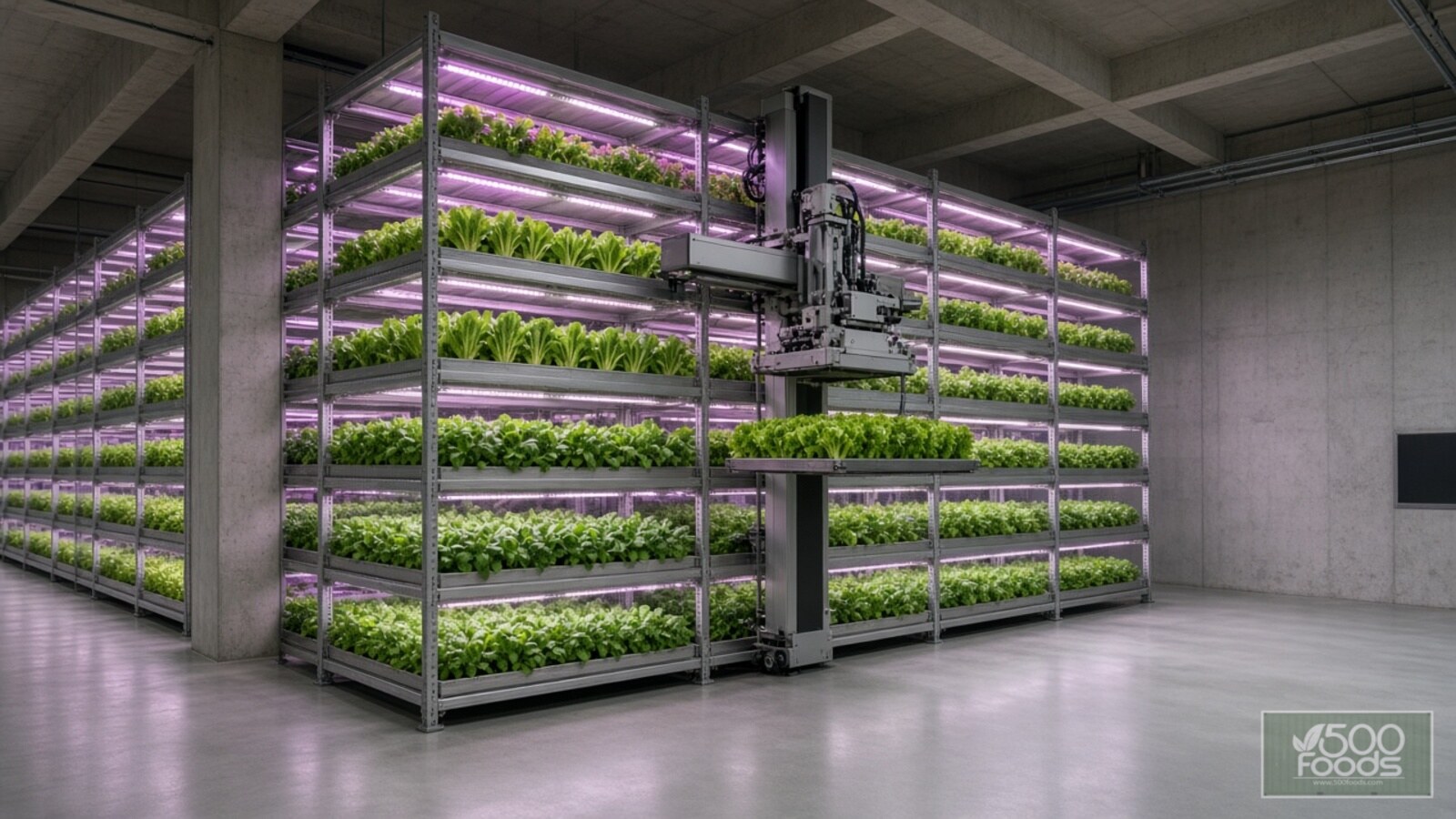
Australian indoor grower Stacked Farm has broken ground on its first US farm, in Menifee, California, after opening a Las Vegas research and customer centre in September. The company says it plans ten US farms within a few years, each built on the same robotic growing platform. For anyone thinking about automated, stacked production at scale, the details are worth a close look.
Stacked Farm has been growing, packing and selling leafy greens commercially in Australia since 2024. Its range covers baby spinach, arugula, romaine and butter lettuce, mixed leaf and mesclun, along with herbs such as basil, mint and parsley. Now it is taking that model across the Pacific, and the way it is doing so says a lot about where large-scale controlled-environment agriculture is heading.
What is being built
The Menifee farm sits in the Northern Gateway Logistics Center, a site the city council approved in July 2025 for two speculative warehouses. Ground was broken on 24 September 2026, and the company is targeting an opening in 2027. Instead of a purpose-built greenhouse, the crop will grow inside an enclosed tilt-up concrete industrial building. Stacked Farm says it intends to use both buildings on the site.
The company describes sealed, climate-controlled grow rooms lit by LEDs, with nutrient water circulating past the roots and about 90 percent of that water recycled. Planting, tending and harvesting are automated, and it says no hand touches the produce between seed and sealed pack. It also reports that an accredited lab screened its greens against 312 pesticides and residues and found none. Every pack carries a code tracing it to the batch and harvest day.
Farming as a factory use
The planning file is one of the most useful parts of this story for would-be operators. Menifee's development code doesn't list controlled-environment agriculture as a use, so the city had to decide what the farm most resembles. Its answer was heavy-intensity manufacturing, a conditionally permitted use in that zone. The deciding factor was trucks: the project expects up to 50 truck trips a day, with room to grow. The city's file also noted that Chicago, Seattle, Newark and Los Angeles already allow indoor farming in industrial zones.
Anyone planning a container yard or warehouse farm should expect the same questions. Zoning, traffic and distribution can matter as much to approval as lights and racks do.
Why it matters for stacked, automated growing
Several parts of Stacked Farm's approach line up closely with the idea of industrial-scale container farming:
- Replication over invention. Each new farm copies a proven platform rather than reinventing the design, the same logic that makes standardised containers attractive.
- Automation instead of aisles. Robots move and harvest the crop, so the growing space can be packed densely, with labour concentrated in packing, maintenance and engineering.
- Warehouse-grade siting. Locating in a logistics park puts production close to distribution and to Southern California's retail buyers.
- A staged entry. A demonstration and research hub came first, then a production farm, a lower-risk way to test a new market.
Indoor farming has had a rough few years, and several well-funded operators have closed farms or failed outright. Ten US farms is an ambitious target, and Menifee will be the first real test of whether this model holds up outside Australia. We'll be watching for yield, energy and cost-per-kilogram figures once the farm is running.
Sources: Stacked Farms Expands with First U.S. Vertical Farming Facility, found via the CEAg World feed. Also drawing on Stacked Farm, the City ofs Menifee Notice of Determination (via CEQAnet) and Menifee 24/7.
How we find, write and illustrate these stories, and how you can share them: see Welcome to Container Culture. Text and AI-generated images are shared under CC BY 4.0.