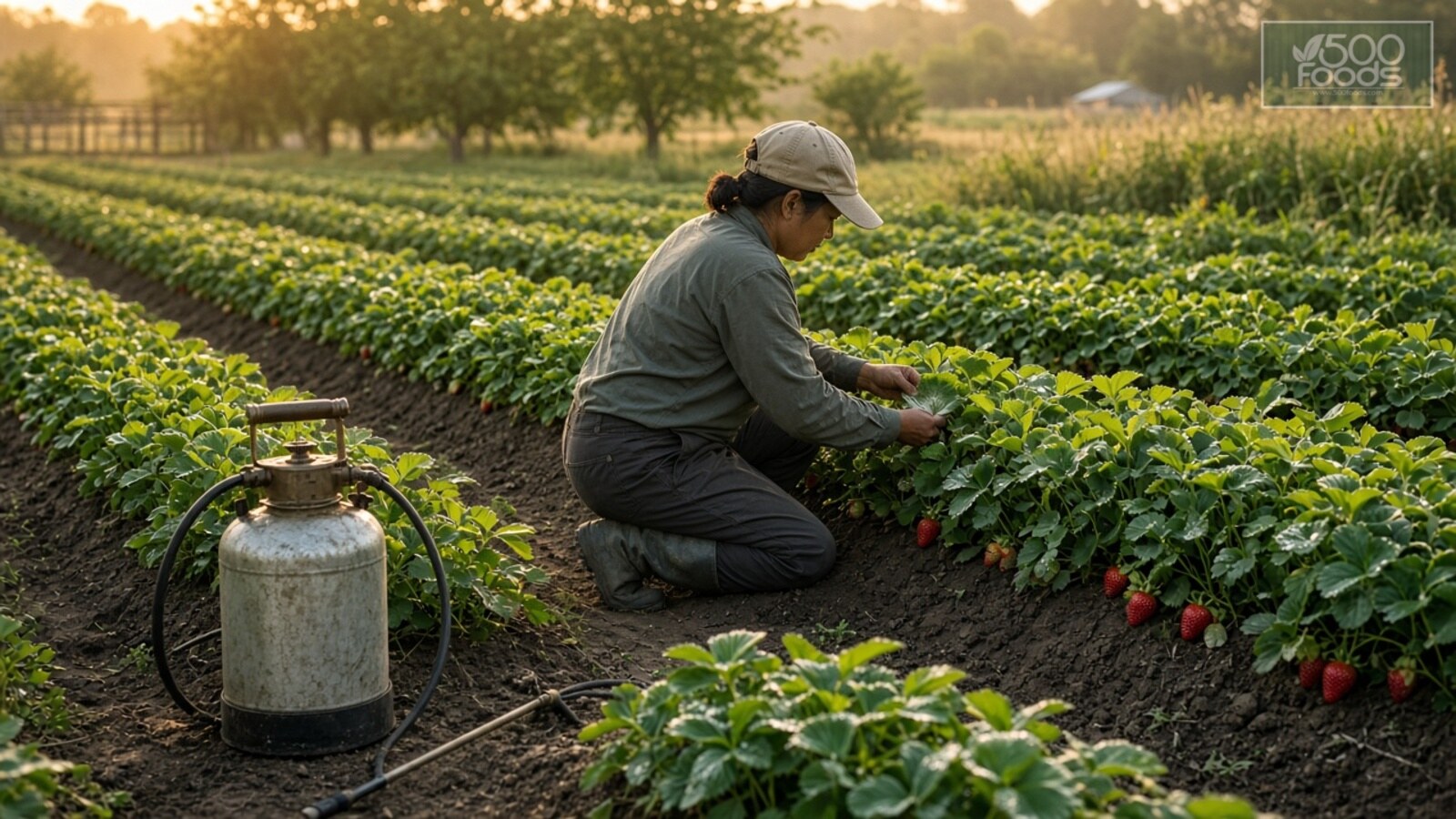
Strawberry powdery mildew is easy to miss until it has already spread. The fungus, Podosphaera fragariae, usually appears first as pale patches on the underside of leaves, then moves onto flowers and fruit, cutting both yield and quality. Fungicides remain the main control, but repeated sprays have helped resistance build in mildew populations. A Kindai University-led team, in a study in Mycological Progress reported by Phys.org Agriculture, has tested whether a beneficial fungus can invade the mildew itself and stop it releasing spores.
The trial
The work was led by Professor Teruo Nonomura at the Laboratory of Phytoprotection Science and Technology, Kindai University, in Nara, Japan, with colleagues at the HUN-REN Centre for Agricultural Research in Hungary and the University of Queensland in Australia. They used a Japanese Ampelomyces strain called Xs-q, isolated in 2017 in Mie Prefecture from a different powdery mildew, Podosphaera xanthii, on cocklebur. The strain does not yet have a formal species name, pending a taxonomic revision of the genus.
The team sprayed Xs-q spores, at 5 × 10⁵ spores per millilitre, onto 10-day-old colonies of a Japanese strawberry mildew isolate, P. fragariae KSP-7N, growing on either the upper or the lower surface of leaves of 60-day-old hydroponic ‘Sagahonoka’ seedlings. Treated plants were then held in a greenhouse at 22 °C and 30–55% relative humidity, or in a growth chamber inside closed boxes at 70–80% humidity. An electrostatic collector trapped any mildew spores released from the colonies. Five colonies were measured in each combination of leaf surface, environment and treatment; water-sprayed colonies served as controls.
What changed
From the treated colonies, the collector caught no mildew spores at all, on either leaf surface and in either environment. Control colonies released hundreds of spores: about 300–330 per colony in the greenhouse and about 650–725 in the growth chamber. Ten days after the Xs-q spray, treated colonies had no intact spore-producing structures (conidiophores) left, and their area had barely grown, while control colonies roughly doubled, or more.
The way the parasite finished the job differed with the setting. In the greenhouse, mildew conidiophores began to wither at 5–6 days and had collapsed completely by 8–9 days, without Xs-q forming its own reproductive structures, called pycnidia. In the growth chamber, pycnidia began to form, mostly in the foot cells at the base of the conidiophores, at 5–6 days and matured by 11–12 days, when the conidiophores collapsed. About 44–47% of those pycnidia sat in the foot cells, with the rest in the middle or towards the tip. The authors suspect the wetter chamber air helped the parasite reproduce, but light and other conditions also differed, so the cause is not settled.
Practical takeaways
- Check the underside. The parasite worked as well on the lower leaf surface, where the disease often starts and is easiest to miss, as on the upper surface.
- Stopping spore release is the immediate benefit. Even when Xs-q did not form pycnidia in the drier greenhouse, it still collapsed the mildew’s spore towers and left none to be collected.
- Humidity may matter for persistence. If the fungus cannot reproduce itself under typical greenhouse or tunnel humidity, a spray may not carry over from one infection cycle to the next. That remains untested.
Caveats
This was a tightly controlled test on single colonies of one mildew isolate, on seedlings of one cultivar, not a whole-plant or field trial. Xs-q is not a registered product, and the authors say application timing, persistence, formulation and methods for producing it at scale still need to be worked out. It is a promising biocontrol candidate, not a drop-in replacement for a spray programme.
References:
- Mycoparasitism of Podosphaera fragariae by an Ampelomyces strain under greenhouse and growth chamber conditions, Ibuki et al., Mycological Progress (2026) 25:72. DOI: 10.1007/s11557-026-02186-4
How we find, write and illustrate these stories, and how you can share them: see Welcome to Better Than Organic.
AI-generated post text and image content are shared under CC BY 4.0.