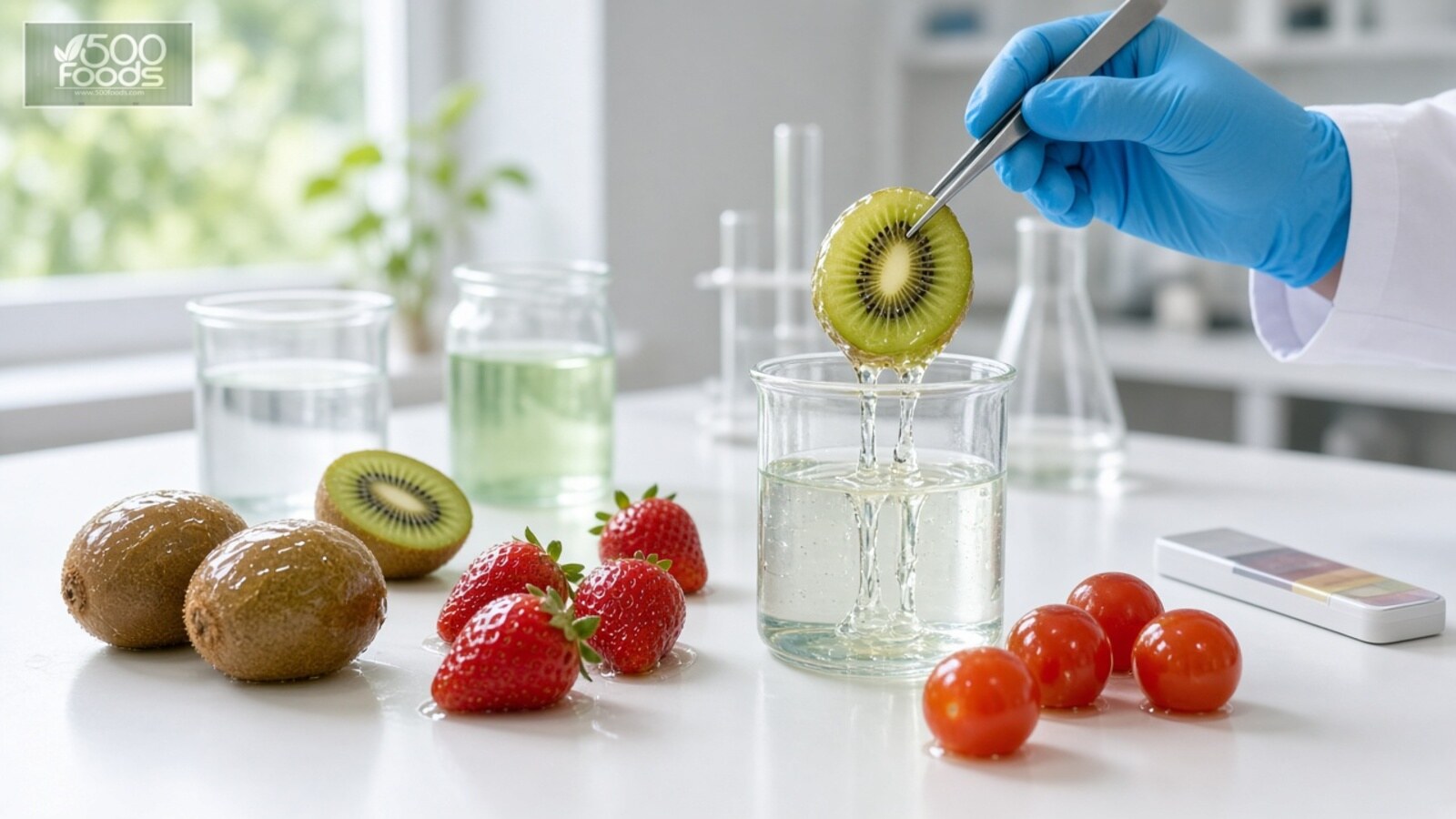
Roughly a third of the world's fruit and vegetables never get eaten, and a large share of that loss happens between the field and the store: bruising in transit, moisture loss in cold rooms, mould in the clamshell. Most of the packaging aimed at that problem sits around the produce as a box, bag or liner. A new open-access review from a team of Chinese postharvest researchers, reported this week by FreshPlaza, looks at a different idea: building the protective layer directly on the surface of each fruit, so the package fits the produce like a second skin.
What "in-situ packaging" means
The review, published on 8 October in Agricultural Products Processing and Storage, groups the work into three families. Coatings are the most familiar: thin edible films sprayed or dipped onto items such as strawberries and cherry tomatoes to slow water loss and respiration. Fibrous membranes are mats of very fine fibres, often made by electrospinning, that can be laid onto fruit and loaded with antimicrobial or antioxidant compounds; the authors cite work on mangoes. Hydrogels are water-rich gels formed on the fruit itself, and they are the newest and most surprising branch.
The appeal is fit. A layer formed on the surface follows every curve of an irregular fruit, so active ingredients are released right where spoilage starts instead of diffusing through the air inside a package. In principle, it also means less separate plastic.
The kiwifruit result
The most striking number in the review concerns physical damage rather than shelf life. Researchers dipped kiwifruit into a solution of sodium alginate, cellulose nanofibres and gelatin, then into a zinc sulphate bath that set it into a clear gel about two millimetres thick. The coating peels off cleanly, needs no adhesive, and cut bruising from vibration, the kind of damage that builds up over long truck routes, by between 34.8 and 53.3 percent. Thin edible coatings have never offered that kind of cushioning.
Other lines of work covered in the review include coatings that tune the exchange of oxygen and carbon dioxide to create a modified atmosphere on the fruit's skin, and layers with built-in sensors that change colour or signal as produce ripens, is squeezed or starts to spoil.
Why growers and buyers should watch, and wait
For anyone moving perishable produce, the targets are familiar: fewer bruised kiwis at the end of a long haul, berries that hold up a day or two longer, less shrink at retail. Edible coatings are already commercial for some crops, which shows there is a market when the economics work.
The authors are candid that most in-situ approaches are still at the lab stage. They list the bottlenecks plainly: materials that suit one fruit but not another, coating unevenly at packing-line speeds, cost per piece, food-safety and regulatory evaluation, and long-term stability. A two-millimetre gel that works on a lab kiwifruit has to be applied, dried and inspected on thousands of fruit an hour before it means anything to a packhouse. The review points to faster film-forming methods, greener processes, responsive and self-healing layers, and links to digital monitoring as the next steps.
For now, in-situ packaging is a direction worth watching rather than a purchase decision. It reframes packaging as part of the produce rather than something wrapped around it.
References:
- Research progress of postharvest in-situ packaging of fruits and vegetables: realization form, functional mechanism and future trend, Tang et al., Agricultural Products Processing and Storage (2026), open access
- Packaging That Grows on the Fruit: The Science of In-Situ Preservation, Bioengineer.org (2026)
How we find, write and illustrate these stories, and how you can share them: see Welcome to Ag Articles.
AI-generated post text and image content are shared under CC BY 4.0.