This post summarises a Hort Americas article built around CropTalk episode 289, a conversation between host Kyle Barnett and John McMahon, president of Equinox Growers. Hort Americas and Hortiplan sponsored the episode, so treat it as a grower's account of his own project rather than an independent review.
If you have a choice, McMahon would start a 10-acre hydroponic greenhouse in winter. He had no choice. In a conversation published by Hort Americas, he told Barnett that Equinox commissioned its Virginia lettuce greenhouse in the dead of summer, and the crop kept growing while the crew worked through calibration.
From 1,500 square feet to ten acres
McMahon left a corporate finance and audit job in New York and bought a rundown piece of Virginia land during the financial crisis. Customers around Charlottesville wanted year-round vegetables, so he built a 1,500-square-foot house with a fixed NFT gutter system from AmHydro. He bootstrapped Schuyler Greens and eventually supplied Whole Foods, Sysco and regional distributors in Virginia.
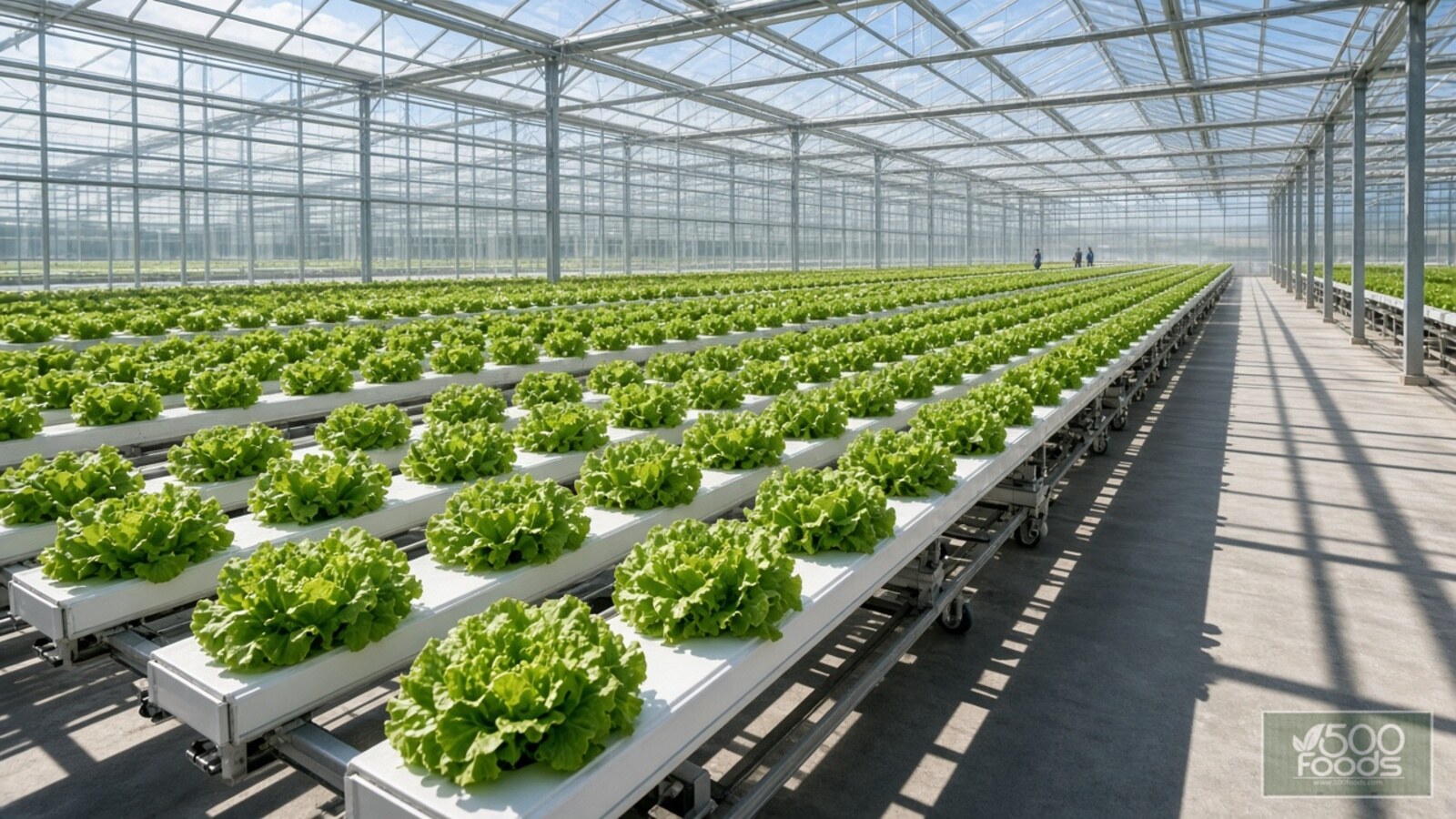
The large project started around 2021 as Better Future Farms, later rebranded Equinox; McMahon took over in 2024. Generate Capital invested, he was the operating partner, and Taylor Farms handled offtake. Production is about 10 acres of head lettuce and baby leaf, in a building he described as almost 15 acres, built by Van der Hoeven with a custom Hortiplan mobile gully system. Taylor Farms acquired the business in March 2026, and McMahon is now a Taylor employee.
Why mobile gullies, not ponds
At Schuyler he began on fixed NFT gutters, then switched to deep-water-culture ponds as the cheapest way to automate, and eventually ran all ponds. The ponds brought their own problems. For the large build he wanted gutters again, but only if they moved. Mobile gully systems were being talked about as among the highest-yielding options, and consultant Tim van Hissenhoven echoed his comparison of gutters and ponds. His business partner pushed back because mobile gullies cost more than ponds; McMahon argued that output and crop quality would be higher.
Investors, private-equity rather than venture-minded and unwilling to be first movers on unproven kit, also shaped the choice. Hortiplan had been building mobile gully systems since the mid-1990s and was backed by Belgium's Arvesta. Capital influenced the size of the building too: McMahon said it can be easier to raise more money than less, because some investors will not write a cheque below a given size.
Commission in winter if you can
Asked what he would tell himself the day before start-up, McMahon came back to the season. In midsummer, long days, high DLI and high temperatures make it hard to put the brakes on a lettuce crop. In December, lights can stay off and the house can be kept cool, so growth cycles stretch out and mechanical systems can be tested more slowly. In July or August, he said, a mechanical hitch can take a crop from in-spec to a tangle of overgrown lettuce in a day: gutters falling over, jams, and too much weight on the hydraulics. He likened it to test-driving a new car at 30 miles an hour rather than 150.
The irony, he said, is that the large house has been easier and more stable than the small one: more automation, more people and more sophisticated kit, even if turning it on was hard. At Schuyler he felt stuck in a mid-scale "no man's land," competing with much larger lettuce suppliers, and concluded he needed to get big or get out. He also argued that chasing a venture-style moonshot does not fit farming, and that a large offtake partner beats fighting for a sliver of shelf space under a new brand.
References:
- What John McMahon Learned Building a 10-Acre Mobile Gully Greenhouse Operation, Miguel Reina, Hort Americas (3 November 2026), based on CropTalk episode 289
- 289. From 1500 Square Feet to Ten Acres w/ John McMahon, Kyle Barnett with John McMahon, CropTalk (27 October 2026)
How we find, write and illustrate these stories, and how you can share them: see Welcome to Ag Articles.
AI-generated post text and image content are shared under CC BY 4.0.