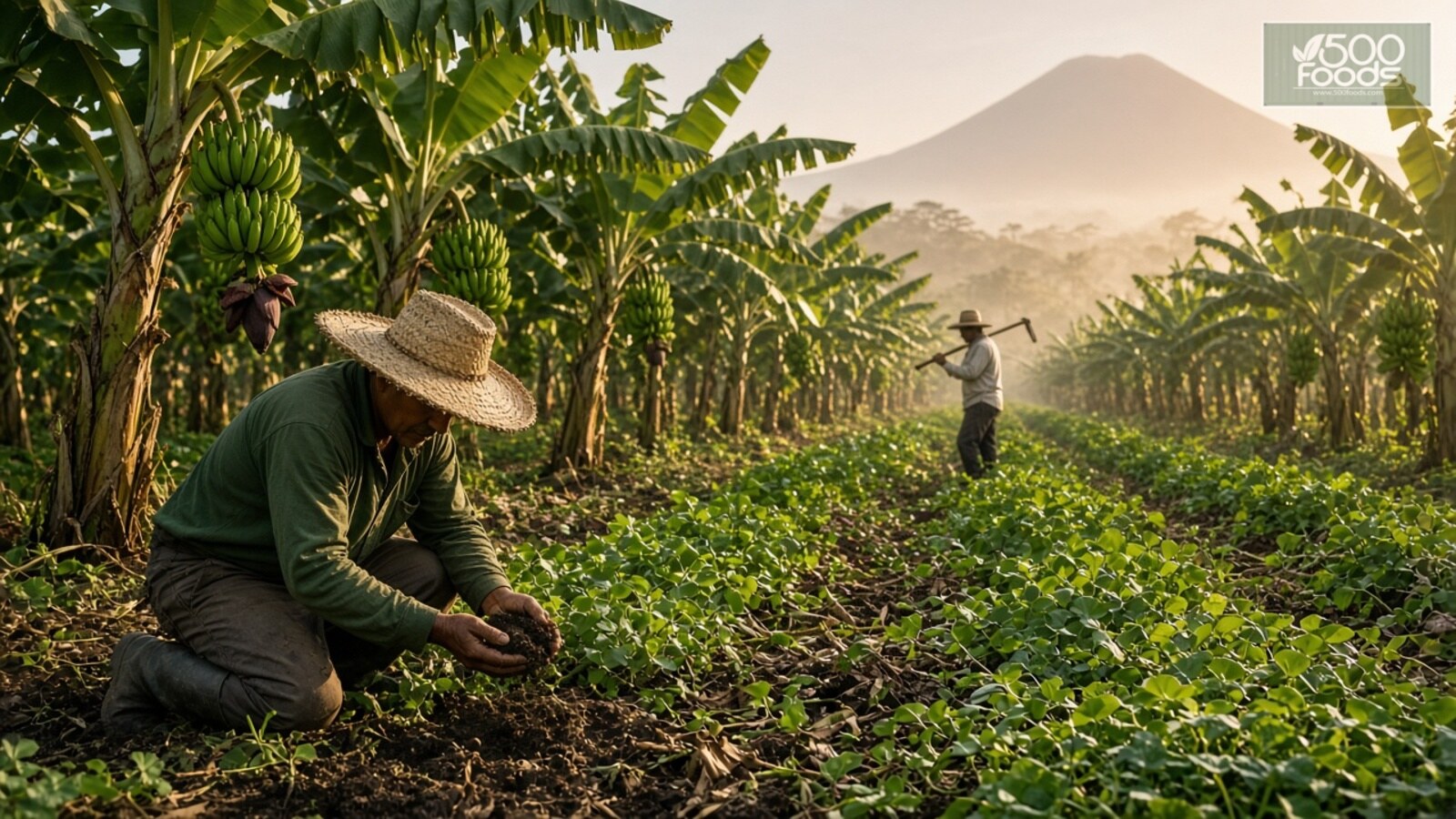
Mexican banana grower Coliman Bananas has added Regenerative Organic Certified (ROC) status on top of its existing organic and Fairtrade credentials. It is a big commercial operation, but the standard behind the label is built for farms of any size, and its rulebook reads like a practical checklist for anyone who wants their ground to get better each year, not just stay clean.
Coliman, part of the family-owned Grupo AGGALL, grows in Colima and works with partner growers in Chiapas, Tabasco, Michoacán and Jalisco. It also sources from Ecuador through a joint venture, where it is now developing organic and regenerative programmes as well. CEO Jorge Ángel Aguilar Gallegos describes regenerative farming as a broader view of sustainability, one that "challenges us to continually improve our practices". He calls the certification an ongoing process rather than a finish line. Banana labels catalogued this year show the fruit carrying the entry-level Bronze mark.
What ROC actually asks for
The Regenerative Organic Alliance built ROC on three pillars: soil health and land management, animal welfare, and farmer and worker fairness. Organic certification (USDA Organic or an equivalent) is the starting point, not the goal. Farms then pick a level:
- Bronze: at least 10 percent of the farm's food-producing land (or revenue) certified at the start, rising to 50 percent by year five.
- Silver: 50 percent at the start, 75 percent by year five.
- Gold: the whole operation, with no-till except at planting.
Every level is re-audited annually. Workers must be paid at least the legal minimum, with a documented plan to close any gap to a living wage. At Gold, a living wage must actually be paid.
Practices any small farm can borrow
You don't need a certificate to use the soil rules, and most of them suit a market garden or hobby farm as well as a plantation:
- Keep the ground covered. Bronze asks for year-round living cover on 25 to 50 percent of cultivated land, and Gold for 75 to 100 percent, including a legume. Between perennials such as bananas, fruit trees or berries, that can mean native ground cover or a seeded mix. When nothing is growing, residues or mulch count.
- Rotate, and rotate widely. Annual crops need at least three crops through the same bed at Bronze, four at Silver and seven at Gold, ideally with a green manure.
- Write down every tillage pass. Each disturbance has to have a reason, such as weeds, seedbed or compaction, and a plan to reduce it over time, using shallow tools where possible.
- Measure. Certified farms run lab and in-field soil tests and keep a record of native plants and wildlife on the farm. A spade test and a notebook are a fine start.
What the label costs
The Alliance's own fees, effective April 2026, are modest for an individual grower: a $350 application (under five parcels), a $300 initial certification and $250 a year for farms with under $1 million of ROC production. On top of that come the certifying body's audit fees, which the Alliance doesn't set, plus the cost of holding organic certification first. Selling under the ROC mark means a separate licence with a $500 minimum.
For a small grower selling direct, the paperwork may matter less than the practices. The bigger lesson from Coliman's move is that buyers are starting to ask what happens to the soil and the people, not only what stays off the crop. A farm that already covers its soil, rotates hard and keeps records is most of the way to answering that question, label or not.
Sources: Regenerative agriculture gains ground in Mexican banana production, found via the FreshPlaza feed. Also drawing on Coliman Bananas, thes Regenerative Organic Alliance's ROC Framework and Cost & Fee Structure, and AndNowUKnow.
How we find, write and illustrate these stories, and how you can share them: see Welcome to Better Than Organic. Text and AI-generated images are shared under CC BY 4.0.