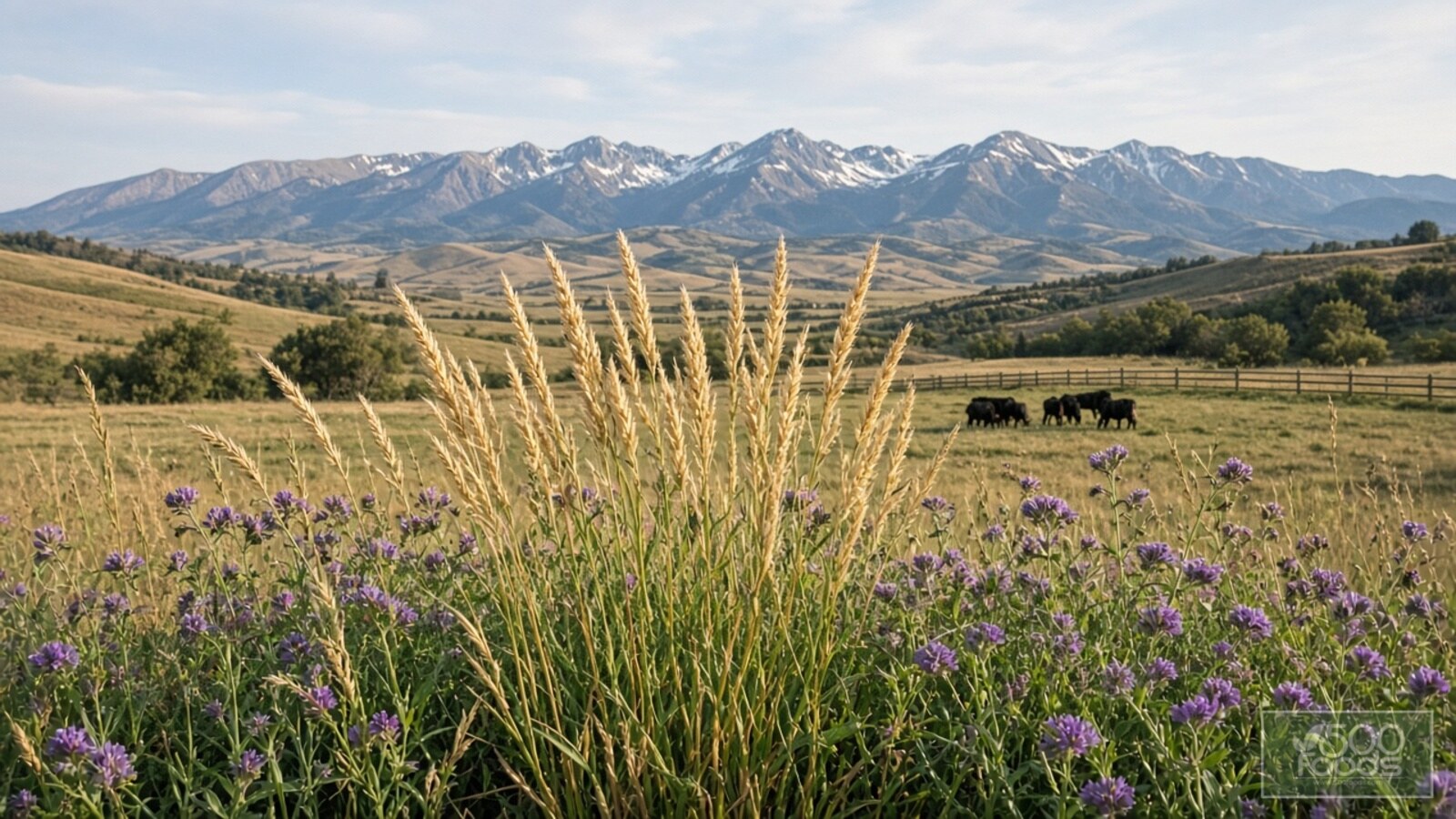
Tillage is the quiet weak spot of organic grain farming. Without herbicides, most organic growers rely on the plough, disc and cultivator to control weeds, and every pass costs fuel, time and soil structure. A Montana ranch family has found a way to park the tillage equipment for years at a time, and their approach is worth a close look from any small farm that wants healthier soil, certified or not.
Jody and Crystal Manuel run a fifth-generation cow-calf ranch near Harlowton, Montana. Roughly two-thirds of their land is too steep to crop. They began moving their cropland to organic in 2007, were fully certified by 2011, and added Regenerative Organic Certification in 2021, according to a profile in Farm Progress.
In 2020 they planted Kernza, the trade name for a perennial grain bred from intermediate wheatgrass. Rather than seeding it alone, they sowed it with alfalfa. The grass gives them a grain crop, while the legume pulls nitrogen from the air. Jody says the mix lets them go seven years or more without disturbing the soil. Once the stand is established, it smothers weeds and improves water infiltration.
What the research says
The pairing is not just a hunch. Kernza has a known problem: grain yields drop as a stand ages. The University of Minnesota reports that yields there typically fall by 180 to 200 pounds per acre each year, starting in year two or three. By year four, a grain harvest is often no longer worth the effort. The decline is linked to the plant shifting energy from seed to roots and leaves, not to a dying stand.
Alfalfa appears to soften that drop. In a five-site Minnesota trial, grain yield fell by 90% in unfertilized Kernza, 80% in Kernza given 80 kg of nitrogen per hectare each spring, and 65% when Kernza grew with alfalfa. By year four, the unfertilized mix matched or beat the fertilized stand at three of five sites. A separate five-year study found that yields from the Kernza and alfalfa intercrop did not decline significantly, while every Kernza-only treatment did.
The mix is not a free lunch. In the first year or two, alfalfa competes with the young grass, and a Missouri study found fertilized Kernza produced about 39% more grain than the intercrop. Yet the same study showed the mix used land more efficiently overall, and its grain yield fell only 28% in a severe drought, compared with 60% or more in the single-crop stands.
Lessons for small farms
The Manuels do not leave the perennial in place forever. After several years of alfalfa, they rotate into spring and winter wheat, emmer, spelt, rye, lentils and chickpeas, drawing on the nitrogen the legume left behind. They also built markets before they had much to sell. Their grain goes into brewing, ancient-grain grits and a historic Montana cereal company they bought in 2022.
Kernza itself is still licensed and its markets are thin, so it will not suit every farm. The wider idea travels well, though. A long-lived grass and legume phase in the rotation can cut tillage, feed the soil and stretch out fertility, whether the final crop is Kernza, hay or pasture. Jody's advice to other growers is simple: start small, study your own soil, and be willing to question what you were taught.
References:
- How to reap benefits from organic farming, Farm Progress (2026)
- Kernza Tech Bulletin: Yield Decline, University of Minnesota Forever Green / Sustainable Cropping Systems (2025)
- Maintaining grain yields of the perennial cereal intermediate wheatgrass in monoculture v. bi-culture with alfalfa in the Upper Midwestern USA, Journal of Agricultural Science
- How the Nitrogen Economy of a Perennial Cereal-Legume Intercrop Affects Productivity: Can Synchrony Be Achieved?, Frontiers in Sustainable Food Systems (2022)
- Intercropping dynamics in a perennial Kernza cropping system, University of Missouri thesis
How we find, write and illustrate these stories, and how you can share them: see Welcome to Better Than Organic.
AI-generated post text and image content are shared under CC BY 4.0.