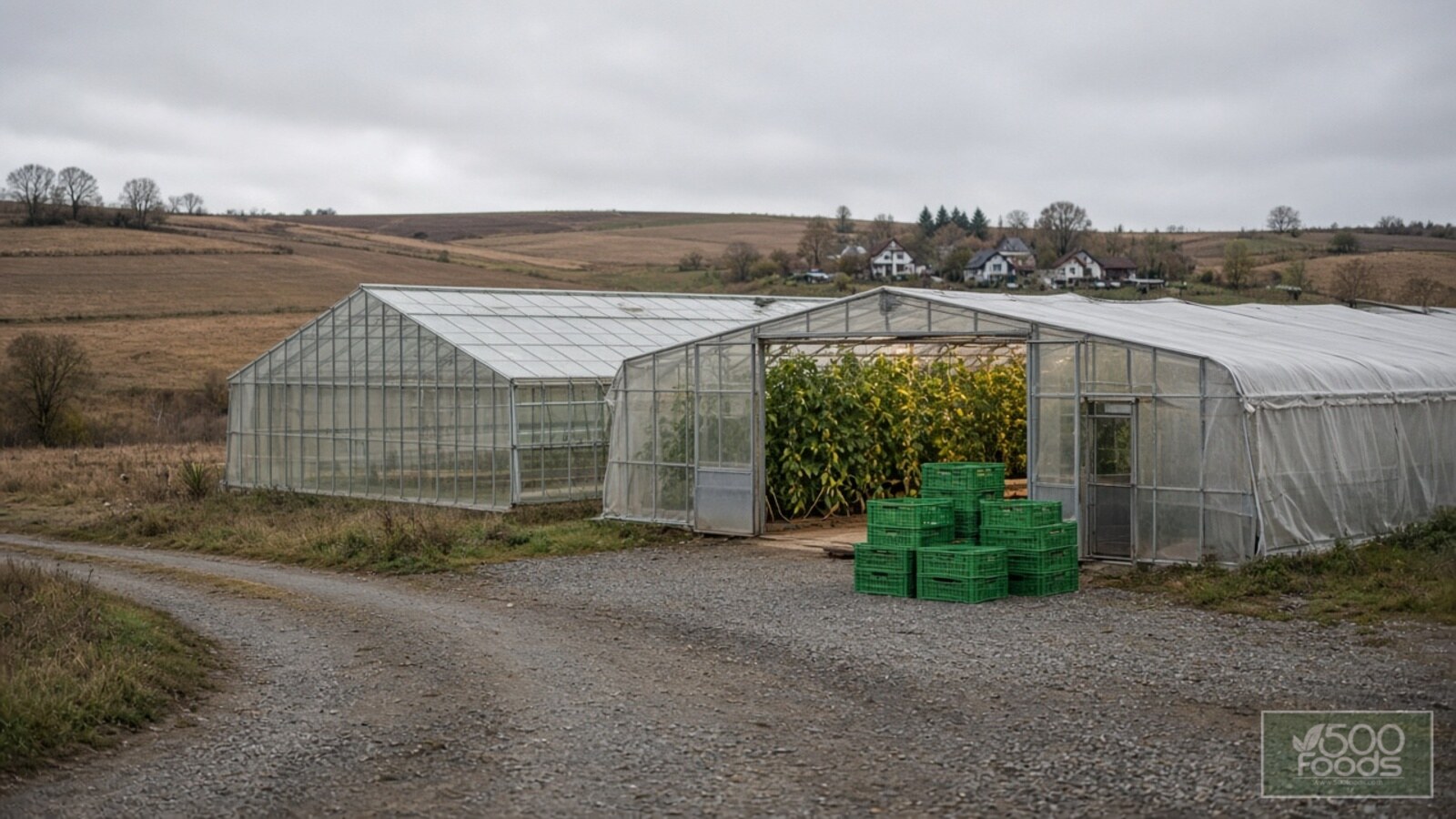
This post draws on a HortiDaily item of 27 November 2026, which reports an EastFruit write-up of an AgroTimes article on a greenhouse market study prepared by APK-Inform for the Netherlands Enterprise Agency (RVO). The area and annual production figures often quoted from that study match the report's 2023 totals.
Ukraine's greenhouse vegetable industry has not only shrunk since Russia's full-scale invasion. It has also moved. The main cucumber and tomato districts, once concentrated in the south and east, now sit in the centre and west of the country, according to the study as reported by HortiDaily, EastFruit and AgroTimes.
A smaller industry, in different places
The full report, commissioned by RVO and written by Valentyna Domkina and Kateryna Volianska, makes the scale of the contraction clearer than the short trade items. APK-Inform's figures show harvested area falling from 7,070 hectares in 2020 to 4,400 hectares in 2023, a drop of about 37 percent. Output fell by about half, from 526,000 tonnes to 258,000 tonnes. Those 2023 totals are what later reports round to "approximately 4,400 hectares" and "nearly 260,000 tonnes" a year. Most of the remaining area is in household plots and other small holdings.
Cucumbers and tomatoes move west and north
Cucumbers and tomatoes still dominate what is grown under cover. Before the full-scale invasion, more than 40 percent of Ukraine's greenhouse cucumbers came from Kherson and Zaporizhzhia, the study says. The centre of cucumber production has since shifted to Dnipropetrovsk, with Zakarpattia and Rivne also taking a larger role. For tomatoes, Kherson and Kharkiv once supplied more than a third of the crop. Almost 45 percent now comes from Kyiv, Ternopil and Dnipropetrovsk together.
The report's regional appendices describe a slightly broader move as well. Vinnytsia and Cherkasy are among the areas that gained after 2022, as growers left occupied or front-line districts and restarted, often at smaller scale and with simpler technology, within one or two seasons. Other crops under cover, including early vegetables, leafy greens and berries, fell much more sharply than cucumbers and tomatoes, from 38,580 tonnes in 2020 to 9,060 tonnes in 2023.
What was lost, and what still constrains production
The losses behind that shift are large. The occupation of southern production hubs in Kherson and Zaporizhzhia, including Kamianka-Dniprovska, took nearly 3,500 hectares of small plastic-film houses out of production — more than half of Ukraine's pre-2022 protected area, the report estimates. Industrial glasshouses have also contracted sharply, from about 600 hectares in 2013 to the 280–300 hectares left in early 2026. War-related occupation and destruction account for about 240 hectares of that industrial loss. Closures driven by energy costs account for about 156 hectares more.
Energy and imports now shape what can still be grown. In winter tomato production, energy can account for 65 to 75 percent of total costs, and cheaper imports, mainly from Turkey, have made winter cropping increasingly unprofitable. Many industrial operators now limit themselves to a spring cycle. Demand has also fallen as the number of consumers has declined, so the report says the market is not in acute shortage, even though domestic output is much lower.
The new map has practical consequences. Supply, transport and packing now have to be organised around different regions, and new production hubs are forming farther from the front. Most surveyed greenhouse operations still have development or investment plans, but credit is scarce because lenders treat the sector as high risk. Anyone selling into, buying from, or investing in Ukrainian greenhouse vegetables will be dealing with a smaller industry, in different places, running on tighter energy margins than it did before 2022.
References:
- How the war in Ukraine has reshaped greenhouse industry, HortiDaily (27 November 2026)
- The Geography of Greenhouse Vegetable Production in Ukraine Has Changed Significantly Due to the War, EastFruit (22 November 2026)
- The geography of greenhouse vegetable production in Ukraine has changed significantly, AgroTimes (Gennadiy Hnyp, 19 November 2026)
- Market report on Needs Assessment: Protected Crop in Ukraine, Valentyna Domkina and Kateryna Volianska, commissioned by the Netherlands Enterprise Agency (RVO), 2026
How we find, write and illustrate these stories, and how you can share them: see Welcome to Ag Articles.
AI-generated post text and image content are shared under CC BY 4.0.