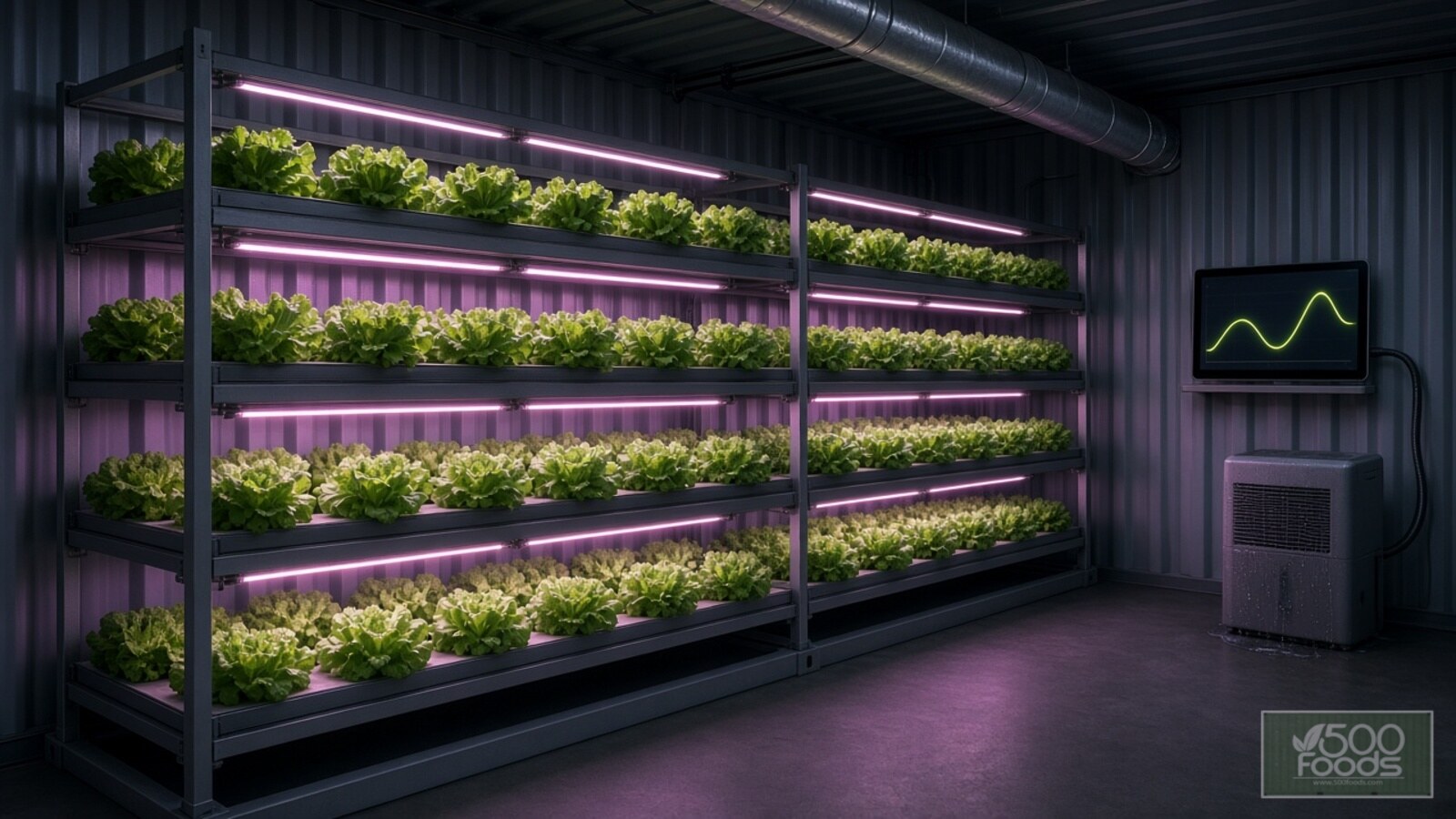
A simulation of a four-level shipping-container lettuce farm found that steering lighting and climate control together, against fluctuating electricity prices, cut energy costs by 13.7% on average while still hitting a fixed 250 g harvest weight. Almost all of the saving came from the climate equipment, not the LEDs.
Electricity is the cost that most often decides whether an indoor farm survives. Many operators already try to run their lights during cheap overnight hours, but a new study in Smart Agricultural Technology argues that this tactic, on its own, leaves most of the available savings untouched. Kiran Kumar Sathyanarayanan, Jonathan Raecke and Stefan Streif modelled a farm built inside an insulated shipping container, with four hydroponic tiers of 12 m² each, growing the Batavia lettuce variety Othilie.
One energy budget, not two schedules
The central insight is that lights and climate share one bill. LEDs illuminate the crop, but they also heat the room, and transpiring plants add moisture. Shifting light into cheap hours therefore shifts cooling and dehumidification load as well, and a controller that ignores this can lower the lighting bill while raising the total. The team built a three-layer controller on a mechanistic model of lettuce growth and indoor climate. A strategic layer plans the whole crop cycle; a day-ahead layer reshapes the next day's plan around published prices; and a 15-minute predictive layer reacts to intraday prices and the measured crop state. Daily biomass checkpoints keep every crop on course for its target weight and harvest date.
What the simulations showed
- Consistent savings. Across 36 scenarios (three countries, four seasons and three light intensities), every optimized run beat a carefully tuned static baseline, with cost savings of 7.3–19.7% (13.7% on average) and 8.4% less electricity on average.
- Climate does the heavy lifting. About 97% of the saving came from climate control, which ran alongside the LEDs in the cheapest hours and kept the air more humid, within crop-safe limits, so less dehumidification was needed. Optimizing lighting alone cost roughly 10% more than co-optimization.
- Volatility pays. Savings tracked the daily spread in electricity prices, from about 10.5% in a stable Norwegian summer to 17.9% in a volatile German spring.
Caveats before anyone rewires a farm
These are computational results. When the authors doubled the growth model's calibration error, many simulated harvests missed their marketable weight, although one biomass measurement per day restored almost all of them. The study also omits sensor noise, equipment cycling, defrost behaviour and peak-demand charges, so field trials with real crop-mass sensing are the necessary next step.
Why it matters for container growers
The modelled farm is essentially a standard container, which makes the findings directly relevant to anyone weighing container production. A controller like this suits sites that run many identical, sealed units under central supervision, because one validated model could be reused across every box. Energy is only part of the picture, however; labour is often cited as a comparable share of operating cost, and software that trims the power bill does not address it. For operators on dynamic tariffs, the practical message is clear enough: treat lighting, temperature and humidity as one system, and the price curve becomes an asset rather than a threat.
References:
- Beyond Light Scheduling: Harvest-Constrained Co-Optimization of Lighting and Climate in Vertical Farms under Volatile Electricity Prices, Sathyanarayanan, Raecke & Streif, Smart Agricultural Technology 15: 102636 (2026)
- Simulated vertical-farm controller cuts costs by co-optimizing light and climate, Bioengineer.org (20 October 2026)
How we find, write and illustrate these stories, and how you can share them: see Welcome to Container Culture.
AI-generated post text and image content are shared under CC BY 4.0.