This post summarises a FreshPlaza interview with Hetendra Singh Rathore, founder of India-based Segritech. The accuracy, sales-mix and value-realisation figures below are the company's own estimates, not an independent evaluation.
Premium fruit can lose value when it is mixed with lower grades, and unsaleable produce can travel hundreds of kilometres before a buyer rejects it. Both problems add cost to an already complicated fresh-produce supply chain, Rathore told FreshPlaza. His company wants to cut those losses by moving AI-powered grading closer to farms and collection centres.
Two ways fruit loses value after harvest
"One of the biggest challenges in the fresh produce industry is the lack of consistent and objective quality assessment across the supply chain," Rathore said. Segritech's answer is to grade earlier, at farms and collection centres, so fruit can be sorted into the right market before it travels.
Grading by defects, not just size and colour
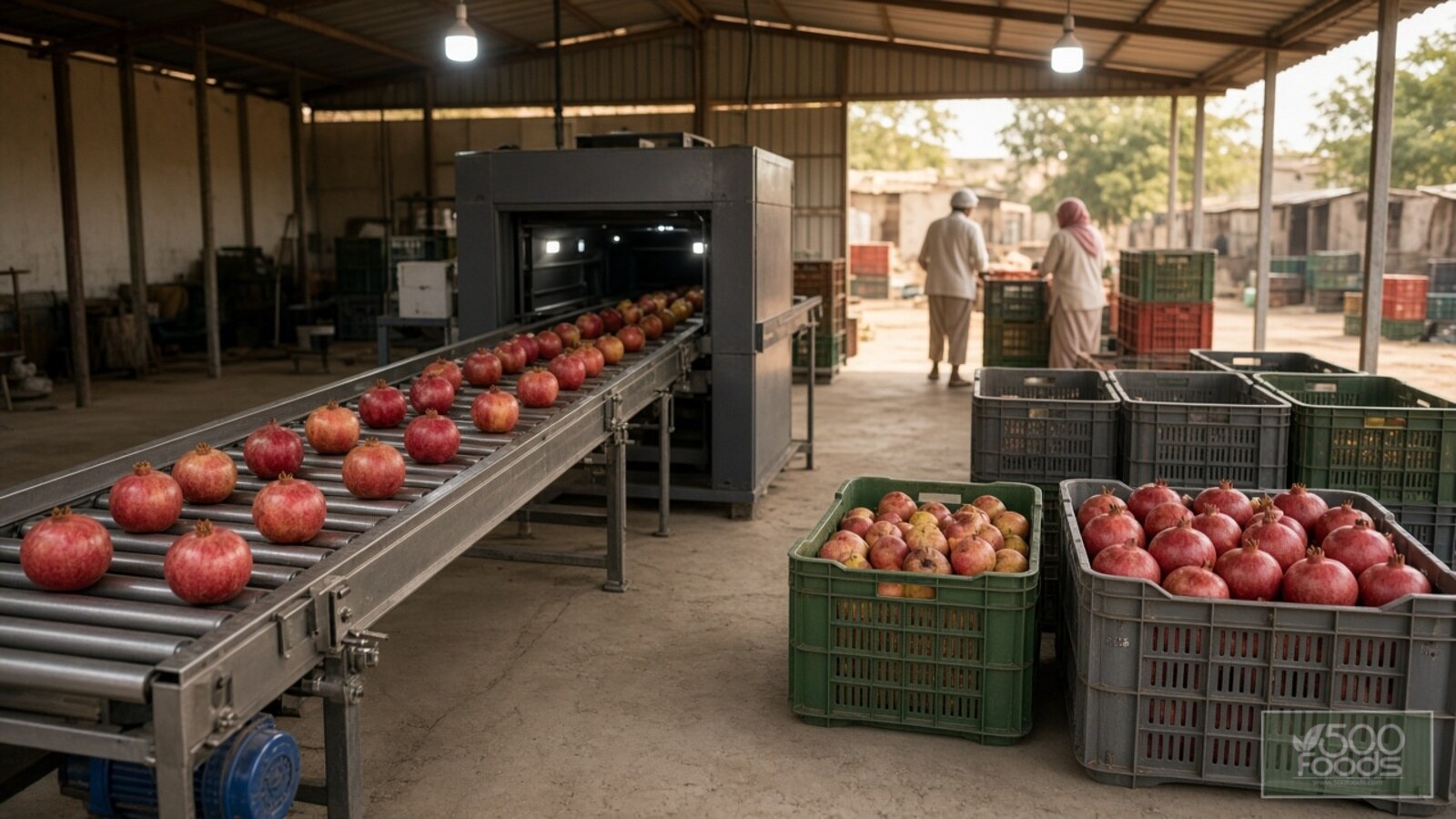
The company combines computer vision, proprietary AI models and custom-built sorting machinery to assess produce in real time. Conventional systems, Rathore said, primarily grade by weight, size and colour. Segritech's technology is designed to identify a wider range of external defects. Its pomegranate model has been trained to recognise more than 200 types of skin defects.
He said the models have demonstrated accuracy of about 95–97% in evaluated applications, compared with an estimated 75–80% for manual grading over sustained operations. Results may vary with the crop and operating conditions.
Cost and infrastructure have long kept automated grading in larger packhouses. Segritech's modular systems can incorporate weight, colour and AI-based defect detection, and can be integrated into existing washing, cleaning, drying and sorting lines.
Who is buying it, and what they hope to gain
Farmers, farmer producer organisations (FPOs) and aggregators can grade to improve price realisation and cut post-harvest losses. Packhouses and exporters can aim for more consistent lots that meet buyers' specifications. Machinery manufacturers can integrate the company's AI modules into existing equipment, and retailers and quick-commerce businesses can check incoming quality and reduce rejections.
Around 80% of sales currently come from the farm-side ecosystem, including FPOs, aggregators and collection centres, with the remaining 20% from the retail side. Rathore reads that split as a sign of growing awareness of the value of grading at the source.
He also estimates that better quality identification and market segregation can improve fruit value realisation by 20–30%, though this is not a guaranteed increase and depends on the crop, market and quality mix. Premium grades can go to export and higher-value retail; other grades can serve domestic markets or processing. Identifying unsuitable produce early, he said, also avoids the cost of transporting and handling fruit that may ultimately be rejected.
Crops, and a push into export markets
Segritech currently works with apples, pomegranates, oranges, tomatoes and dragon fruit. Apples, pomegranates and oranges are the strongest demand categories, with interest in tomato grading also increasing. Mangoes, guavas and kiwis are potential applications, but each would require crop-specific data collection, model training and validation before commercial deployment.
Over the next three to five years, Rathore expects demand to grow as labour availability, quality expectations and export requirements drive investment in automation. The company is also exploring international markets, including Europe, and plans to expand through direct customer deployments and partnerships with machinery manufacturers.
The longer-term aim, starting in India, is large-scale digitization and more consistent, transparent quality assessment across the fresh-produce supply chain. "The future of agricultural automation is not just about building faster machines. It is about building machines that can see, understand, and act," he said.
References:
- AI grading moves closer to the farm to prevent two sources of value loss, FreshPlaza (27 November 2026)
- Segritech, company website
How we find, write and illustrate these stories, and how you can share them: see Welcome to Ag Articles.
AI-generated post text and image content are shared under CC BY 4.0.